

Nitinol devices and components cover a wide range of products, from demonstration parts such as shape memory paper clips and heat engines to serious engineering components made from wire, strip, sheet, tube, rod, or formed shapes. The phrase is useful for searching, but it is too broad for a purchase order. A buyer should first decide whether the need is raw material, a semi-finished component, a demonstration product, or a custom part that will become part of a larger assembly.
GEE SMA product notes place nitinol devices and components in a category that includes nitinol paper clips, nitinol engines, nitinol motors, nitinol flowers, nitinol rings, and nitinol knives. The same broader product range also includes wire, actuator wire, springs, sheets, foils, strips, rods, tubes, and special alloy families. GEE SMA's shape memory alloy product range gives buyers a useful map: component discussions should begin with the material form and function, not with a generic device label.
Component Is Not the Same as Finished Device
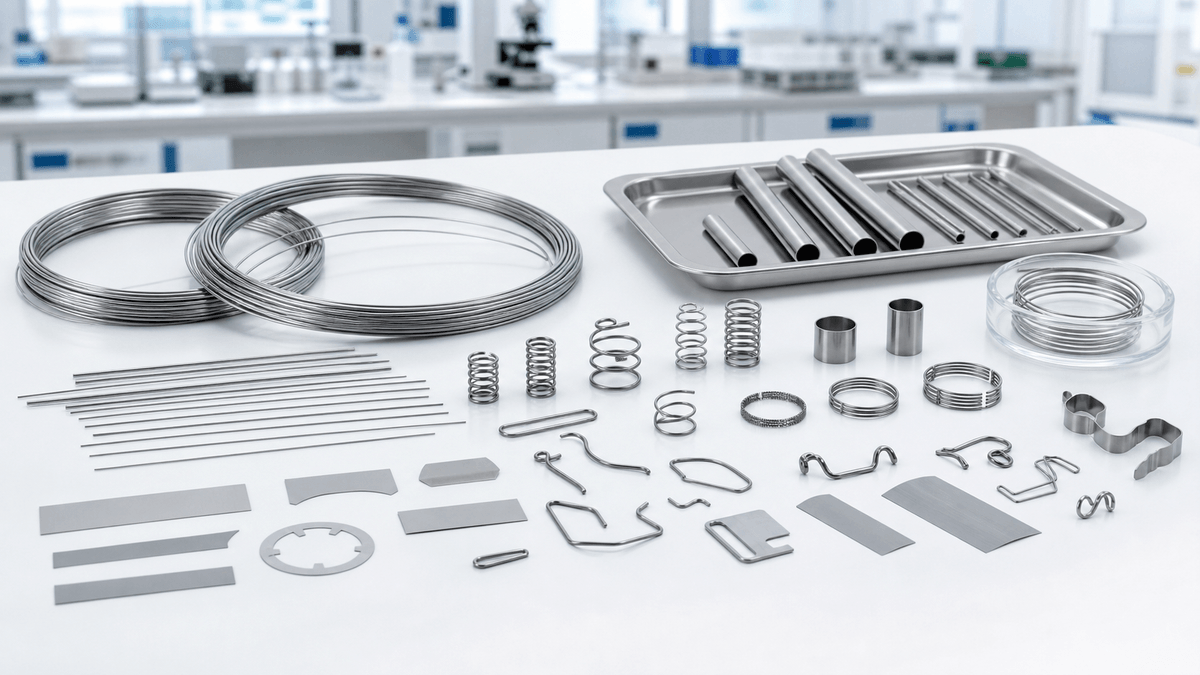
A nitinol component can be a wire form, spring, loop, frame, clip, ring, tube segment, sheet part, or demonstrator. A finished device is the complete product placed into a market with defined labeling, use environment, validation, and responsibility. That distinction matters most in medical, dental, aerospace, and safety-related applications. The material supplier may provide alloy stock or a custom component, while the OEM remains responsible for final design verification, regulatory strategy, and use claims.
For medical-related projects, this boundary should be explicit. Nitinol is widely used in medical devices, but that does not make every nitinol component a finished medical device. FDA guidance on devices containing nitinol focuses on non-clinical assessment, transformation behavior, fatigue, corrosion, nickel release, and the final manufactured state. A material or component discussion should support those engineering questions without promising clinical outcomes.
GEE SMA's nitinol biocompatibility discussion is relevant when a component may enter a patient-contacting design. It keeps the focus on surface condition, corrosion, nickel release, and OEM verification rather than loose claims.
Start With the Functional Behavior
Nitinol components are selected because the alloy can provide shape memory behavior, superelastic recovery, thermal actuation, kink resistance, spring force, or compact motion. Those behaviors are not interchangeable. A demonstration paper clip that recovers shape in warm water may use a different transformation temperature than a superelastic guidewire-related component or a wire-type motor.
GEE SMA product notes describe shape memory paper clips with different active Af concepts: one-way shape memory versions that recover in hot water, superelastic versions with lower active Af, and palm-temperature demonstration versions around the warmth of the hand. These products are useful teaching examples because they show the same family of alloy behavior in different temperature windows. For engineering sourcing, the same lesson applies: define the behavior first, then define the material.
GEE SMA's technical information on shape memory and superelasticity helps separate temperature-induced recovery from stress-induced recovery. That distinction should guide the first component specification.
Product Form Drives Manufacturing Risk
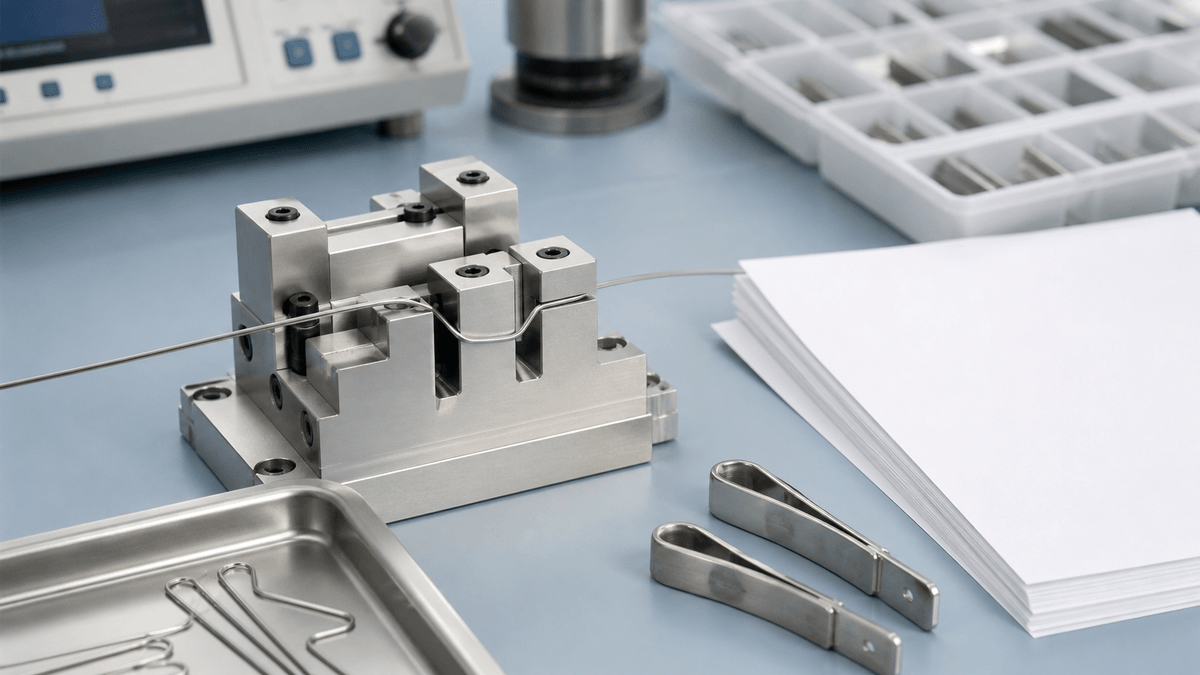
Nitinol devices and components may begin as wire, flat wire, sheet, foil, strip, rod, tube, or spring stock. Each form creates a different process route. Wire may be drawn, straight annealed, shape set, coiled, bent, crimped, welded, or polished. Sheet and foil may be laser cut, stamped, heat set, or surface finished. Tube may be laser cut, centerless ground, etched, or cleaned internally. Rod and bar may require machining and larger-section heat treatment discussions.
Because nitinol behavior is process-sensitive, the starting form cannot be treated as a commodity choice. Cold work, heat treatment, surface condition, and final geometry all affect recovery behavior. A design team that orders a finished-looking component without discussing the starting material may discover late that the surface, Af, bend radius, or fatigue margin is not what the application requires.
GEE SMA's nitinol wire capability is central when a component starts as fine wire or custom formed wire. For more complex geometry, GEE SMA's custom wire forming capability matters when the final shape, bend, loop, or spring geometry becomes part of the performance requirement.
Surface Finish Belongs in the First Drawing
Surface finish is often discussed too late. For nitinol components, it can affect friction, appearance, corrosion behavior, coating adhesion, fatigue initiation, nickel release, cleaning, and inspection. GEE SMA product information and product notes include surface options such as black oxide, light oxide, mechanically polished, centerless ground, pickled, and other custom finishes depending on product form.
For a demonstration product, surface finish may be mainly visual and handling related. For a medical or high-cycle component, surface finish can become a verification issue. Scratches, oxide inconsistency, burrs, heat-affected zones, and embedded residues may matter more than the buyer expected. A supplier should therefore know whether the component will be polished, passivated, coated, sterilized, assembled, or cycled after delivery.
GEE SMA's nitinol passivation and surface-control guidance is useful when the buyer needs to connect raw material finish, post-processing, and final component surface expectations.
Demonstration Components Still Need Specifications
Nitinol engines, flowers, forks, paper clips, and other demonstration products may look simple, but they still depend on transformation temperature, shape setting, stress level, and thermal path. GEE SMA product notes describe nitinol engines as two-wheel heat-engine demonstrators using a nitinol wire loop, with hot water driving one side and ambient air cooling the other. Those notes also describe the engine as suitable for science museum displays, teaching products, gifts for science enthusiasts, and similar educational uses.
For these products, the buyer should define the demonstration environment. What temperature source will be available? Does the product need to reset at room temperature? How many cycles are expected? Is it a sample for education, a branded kit, or a custom display? Even educational components are more reliable when Af, wire strain, wheel geometry, and packaging are treated as design inputs.
GEE SMA's nitinol wire motor capability is related because it turns the same thermal-material logic into useful compact motion for prototypes and small mechanisms.
Medical and Industrial Components Need Different Evidence
A nitinol component for a consumer demonstration product does not need the same evidence package as a component for a regulated medical device. A medical-device OEM may need material certificates, ASTM F2063 alignment for applicable mill product, transformation temperature data, surface records, corrosion testing, nickel release evaluation, fatigue testing, cleaning validation, and traceability. An industrial mechanism may care more about force, stroke, response time, cooling path, electrical current, wear, and cycle life.
This is why a supplier cannot responsibly answer every nitinol devices and components request with one catalog item. The correct answer depends on the final use, the risk level, and which performance mode matters. ASTM F2063, ASTM F2516, FDA nitinol guidance, and application-specific testing may all become relevant in different situations.
GEE SMA's medical nitinol material-control approach is helpful when the buyer needs documentation discipline. For non-medical products, the same mindset can still improve lot consistency and prototype reliability.
A Better RFQ for Nitinol Components
- State whether the request is for raw material, a semi-finished component, or a finished demonstration product.
- Define the required behavior: superelastic recovery, shape memory activation, thermal motion, spring force, or display effect.
- Specify starting form: wire, flat wire, sheet, foil, strip, tube, rod, spring, or custom shape.
- Include dimensions, tolerances, active Af target, surface condition, and delivery condition.
- Describe downstream processing such as forming, heat setting, welding, polishing, coating, cleaning, or assembly.
- Clarify validation responsibility for final product claims, especially in regulated applications.
Nitinol devices and components are strongest when the material science is not hidden behind a product name. A clear RFQ lets the supplier recommend an alloy family, form, surface, and process route that match the real function. It also keeps responsibility clear: GEE SMA can support material and component sourcing, while the OEM owns the final device design, use claims, and validation path.