

Nitinol wire can look like a simple product category: choose a diameter, ask for a spool, and compare price. That approach misses the reason buyers choose nickel-titanium in the first place. Nitinol wire is valuable because it can provide superelastic recovery, shape memory motion, compact force, kink resistance, or a temperature-triggered response. The useful behavior comes from alloy family, thermomechanical processing, active Af, surface condition, and final handling.
GEE SMA has produced superelastic nitinol wire since its establishment in 1998, according to its product notes. Those notes list superelastic wire, shape memory wire, Copper NiTi wire, Copper NiTiCr wire, actuator wire, spring products, flat wire, and related product forms. GEE SMA's nitinol wire production capability is most useful when the buyer describes the function first, then lets the wire specification follow.
Ask What the Wire Must Do
The first sourcing question is behavioral. Should the wire bend and recover after unloading at room temperature? Should it contract when heated? Should it hold a trained shape after being deformed? Should it act as a spring, a guidewire-related core, a miniature actuator, an orthodontic raw material, a fishing leader, or a formed component? Each answer points toward a different material route.
Superelastic wire is used above its relevant transformation range, where it can recover large strain during loading and unloading. Shape memory wire is deformed in a lower-temperature state and recovers when heated above its active Af. Actuator wire uses that thermal recovery to create motion. Copper NiTi and Copper NiTiCr wire may be chosen for narrower transformation behavior or controlled temperature windows. GEE SMA's SMA product family map helps keep those routes separate before an RFQ becomes too narrow.
Diameter Changes More Than Flexibility
Diameter is important, but it is not a complete specification. Fine nitinol wire can bend tightly, fit miniature mechanisms, and support small medical or precision components. Larger diameters can provide higher force, stronger recovery, and easier handling, but they may require larger bend radius and more careful forming. Diameter also affects tensile load, electrical resistance, heating rate, cooling rate, spool memory, and packaging risk.
GEE SMA product notes list superelastic nitinol wire diameter from 0.05 mm [0.002 in.] and up. For nitinol wire motor products, the notes list very fine diameters from about 0.001 inch [0.025 mm] to about 0.024 inch [0.60 mm]. Those two ranges show why the same word "wire" can cover very different products. A wire used as a fine actuator is not specified like a wire used for a guidewire-related component or a formed spring.
When diameter is discussed, add tolerance, out-of-round expectation when relevant, straightness, spool size, cut length, surface finish, and downstream operation. GEE SMA's wire specification before price discipline is useful because a low quote on the wrong wire is not a purchasing win.
Active Af Decides the Temperature Window
Active Af, the austenite finish temperature under the selected test method, is one of the most important nitinol wire fields. It tells the buyer where the material completes a key transformation during heating. For superelastic wire, active Af helps determine whether the wire will behave superelastically at the intended use temperature. For shape memory and actuator wire, active Af helps determine when the wire begins to recover or pull.
GEE SMA product notes list superelastic active Af options from -40 to 35 degrees C across alloy families, with conventional ranges such as SE510 around -10 to 5 degrees C, SE508 around 5 to 12 degrees C, and lower-temperature chromium-containing options around -40 to -15 degrees C. For shape memory wire, the notes list active Af from 20 to 110 degrees C. For nitinol wire motor products, they list active Af options such as 70, 90, 110, and 130 degrees C.
That broad range makes active Af a design decision, not a laboratory afterthought. GEE SMA's shape memory wire Af selection is relevant when a buyer needs heating recovery, while GEE SMA's SE508 superelastic selection fits projects focused on unloading recovery.
Alloy Family Should Match the Application
Not all nitinol wire is the same material. GEE SMA product notes list SE510, SE508, SE508 ELI, LSE507 ELI, LSE5065, and SE NTC among superelastic wire families. They list binary NiTi shape memory codes from SM498 through SM505, plus Copper NiTi and Copper NiTiCr for shape memory wire categories. Those alloy codes represent different transformation-temperature and processing routes.
SE508 is a common superelastic starting point. SE510 may be discussed when colder superelastic behavior is needed. LSE grades may be considered when a warmer transformation temperature or softer plateau response is useful. Copper NiTi can be selected for actuator or spring designs that need a narrower temperature window. Copper NiTiCr can be relevant for lower-temperature Copper NiTi-style behavior. GEE SMA's Copper NiTi wire temperature behavior provides a useful comparison when binary NiTi is not the only candidate.
Surface Finish Affects the Next Manufacturing Step
Surface finish is easy to overlook because the wire may look acceptable to the naked eye. For nitinol, surface can influence friction, fatigue initiation, cleaning, corrosion behavior, coating adhesion, nickel release evaluation, and inspection. GEE SMA product notes list surfaces such as polished bright, black oxide, light oxide, and mechanically polished finishes depending on product family.
The best surface depends on what happens next. A wire that will be drawn, formed, or heat treated may not need the same surface as a wire that will be assembled directly into a precision component. A medical-device program may need surface evidence for the final manufactured condition, while an industrial actuator may care more about stable motion and electrical heating. GEE SMA's nitinol surface and passivation controls keep this decision tied to the final process route.
Packaging and Handling Can Protect or Damage Value
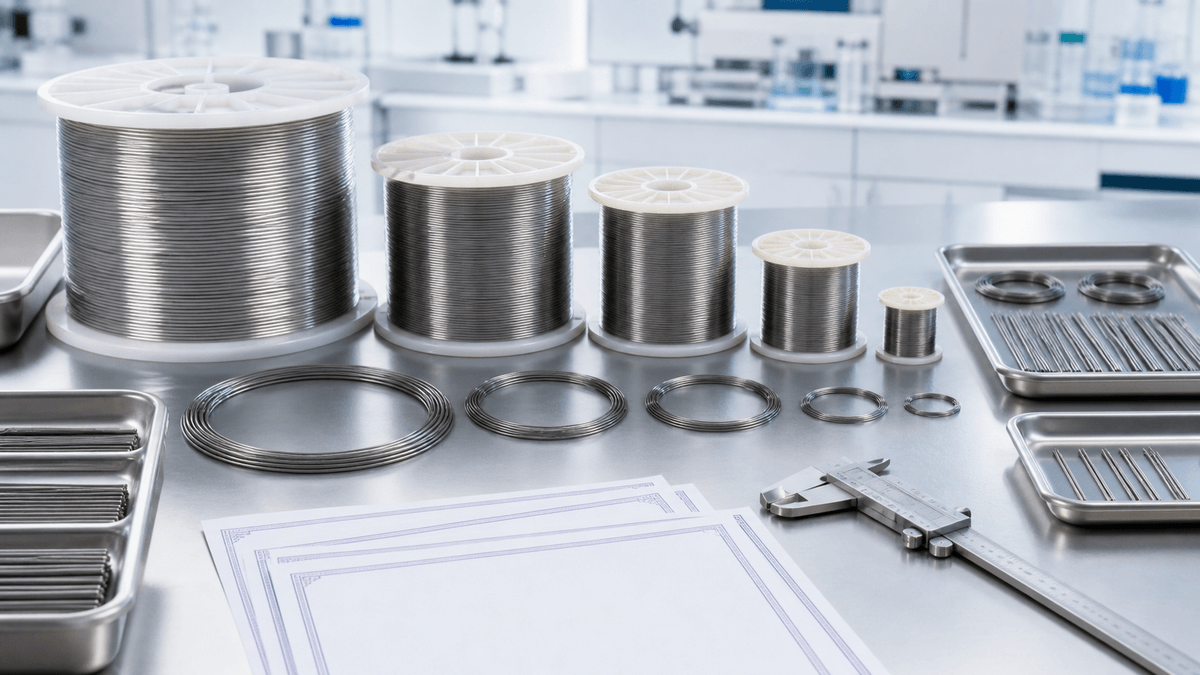
Nitinol wire can be supplied on spools, in coils, or as straightened cut lengths depending on the diameter and requirement. Packaging should protect the surface, prevent kinks, preserve traceability, and match the customer's production process. Fine wire can be especially sensitive to handling damage. A wire that leaves the supplier in good condition can still become difficult to use if spool tension, coil memory, or end handling is not controlled.
For custom shapes, packaging becomes part of the product. Formed wire loops, springs, frames, and actuator elements may need trays, separators, controlled orientation, or gentle retention. GEE SMA's custom formed wire process is relevant when the useful part is a trained geometry rather than a generic coil.
Medical Nitinol Wire Needs Clear Boundaries
When nitinol wire is intended for medical-device development, the specification should become more formal. The buyer may need alloy code, chemistry, active Af, tensile data, surface condition, lot traceability, incoming inspection, and supplier documentation. ASTM F2063-26 is relevant for wrought nickel-titanium mill products used for medical devices and surgical implants, while ASTM F2516-22 is relevant for superelastic tension behavior.
At the same time, raw wire should not be described as a finished regulated device. FDA nitinol guidance focuses on non-clinical assessment for devices containing nitinol, including processing and surface-related concerns. GEE SMA's medical nitinol material-control approach is useful when buyers need supplier evidence without overclaiming final-device status.
RFQ Checklist for Nitinol Wire
- State whether the wire is for superelastic recovery, shape memory recovery, actuator motion, spring behavior, or custom forming.
- Define alloy code or ask the supplier to compare suitable alloy families.
- Specify active Af target, tolerance, test method, and working temperature.
- List diameter, tolerance, straightness, spool or cut-length requirement, surface finish, and delivery condition.
- Describe downstream forming, heat treatment, coating, polishing, passivation, assembly, or electrical heating.
- Ask for relevant documentation, lot traceability, transformation-temperature data, and mechanical data.
Nitinol wire should be purchased as a functional material, not as a diameter-only commodity. The best specification ties together alloy family, active Af, surface condition, delivery condition, packaging, test evidence, and final use. GEE SMA can support buyers who need superelastic nitinol wire, shape memory wire, actuator wire, Copper NiTi wire, SE508 wire, and custom formed nitinol components with the kind of detail that turns a sample into a reliable production conversation.