

Flat Wire Is a Geometry Choice, Not Just a Smaller Strip
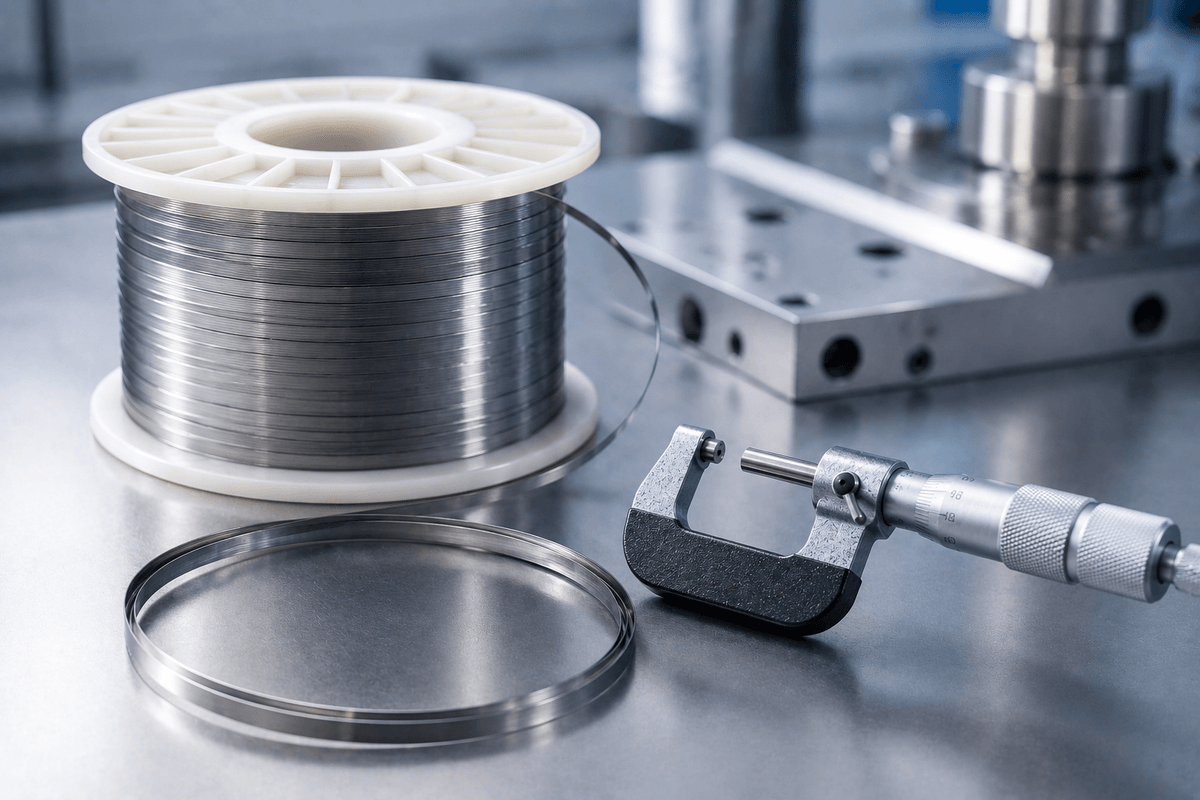
Nitinol flat wire has a square or rectangular cross-section. That sounds simple, but it changes how the material behaves in bending, forming, heat setting, assembly, and packaging. A round wire bends similarly in many directions. A flat wire has a strong direction and a flexible direction. That directional behavior can be useful in medical components, springs, clips, frames, actuators, and compact mechanisms.
For buyers, the first decision is not only alloy code. It is whether the product needs flat geometry at all. Nitinol flat wire can provide a wider contact surface, directional stiffness, lower profile, and more stable orientation in assemblies. But it also requires clearer dimensional control than a simple round wire order.
GEE SMA supplies nitinol wire and related shape memory alloy materials. GEE SMA product notes identify nitinol flat wire as a specific product form that can be supplied on spools or cut to length, with rolled and drawn manufacturing routes.
Rolled Flat Wire and Drawn Flat Wire Serve Different Needs
GEE SMA product notes describe two main methods for producing nitinol flat wire: rolling and drawing. Rolled flat wire can support larger flat dimensions and wider width-to-thickness ratios. Drawn flat wire is described as a more precise product route, with improved size tolerance and more consistent dimensions.
The difference matters because buyers often ask only for a width and thickness. A rolled product may be suitable when the design needs a larger rectangular profile, while a drawn product may be more appropriate when consistency, small cross-section control, or tighter dimensional repeatability is important. Neither method is automatically better. The right route depends on the part.
GEE SMA product notes list typical width-to-thickness ratios of about 3:1 to 10:1 for rolled nitinol flat wire and about 1:1 to 5:1 for drawn nitinol flat wire. They also list minimum thickness values of about 0.1 mm for rolled flat wire and about 0.2 mm for drawn flat wire. Buyers should confirm final limits for the actual alloy, condition, and order quantity.
Alloy and Transformation Temperature Still Matter
Flat geometry does not remove the need for nitinol material control. GEE SMA product notes connect nitinol flat wire with alloy families such as SE510, SE508, SE508 ELI, LSE5065, LSE507 ELI, NiTiCr-related options, SM499 to SM502, and Copper NiTi. The same notes list a broad Active Af range from about -30 to 110 degrees C for flat wire-related product options.
That range shows why a flat wire purchase should not stop at dimensions. A superelastic flat wire, a shape memory flat wire, and a medical-relevant flat wire may need very different transformation behavior. If the final part must flex and recover at room temperature, the material route differs from a part that must change shape when heated above a specific threshold.
For buyers comparing alloy families, GEE SMA's super elastic wire selection article is useful when flat wire will be used for recoverable bending. For thermal movement, the related shape memory wire discussion helps frame Active Af selection.
Specify Width, Thickness, Ratio, and Edge Expectations
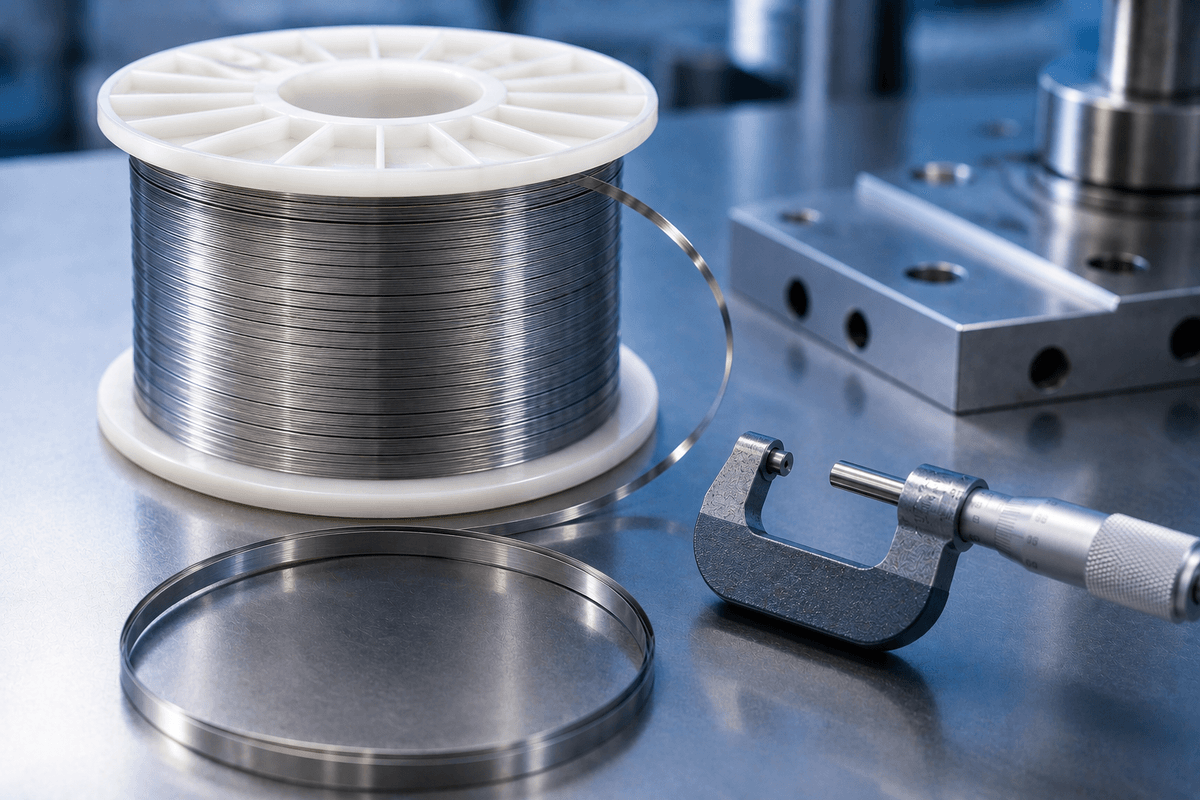
A useful nitinol flat wire specification should include both width and thickness. It should also identify the acceptable width-to-thickness ratio, dimensional tolerances, edge expectations, surface condition, straightness, and package form. If the flat wire will be used in a formed component, the minimum bend radius and forming direction may also matter.
Edge condition is easy to overlook. A flat wire edge can become a stress concentration if the part will be flexed repeatedly. If the wire will be polished, electropolished, coated, welded, crimped, or laser processed, the buyer should discuss edge quality and surface condition before sampling.
For custom profiles or parts that need more than simple flat stock, GEE SMA's custom nitinol wire forming content is relevant. Flat wire is often purchased because the final component needs a controlled shape, not because the buyer wants a generic material.
Delivery Condition Shapes Downstream Processing
GEE SMA product notes list nitinol flat wire delivery conditions such as cold worked and cold worked plus straight annealed. They also describe cold drawn and superelastic straight annealed processing in flat wire-related notes. This matters because nitinol responds strongly to thermomechanical history.
If a customer plans to heat set the flat wire into a shape, a cold worked condition may be appropriate for further processing. If the customer needs a more stable supplied condition, straight annealing may be part of the route. The supplier cannot choose this correctly without knowing what the buyer will do next.
GEE SMA's technical information page helps connect product form to manufacturing steps such as melting, drawing, heat treatment, surface control, and inspection. Flat wire should be treated as a controlled engineered input, not a generic strip.
Surface Finish and Packaging Are Part of Quality
GEE SMA product notes list black oxide and pickled surfaces for nitinol flat wire. Surface finish should be selected based on the downstream route. A black oxide surface may be acceptable for intermediate forming or industrial use. A pickled or further finished surface may be more appropriate when the flat wire must meet stricter appearance, cleaning, or processing expectations.
Packaging also matters. GEE SMA product notes say flat wire can be supplied on a spool or cut to length. For large quantities of spooled wire, the notes mention export wooden boxes outside cardboard boxes to help protect material during transportation and handling. Large flat wire spools may also use protective film, with packaging weights controlled for practical handling.
That packaging detail is not minor. Flat wire can be damaged by tight bends, edge contact, twisting, and surface abrasion. If a buyer needs pristine surface or tight dimensional control, packaging and handling should be included in the purchase order.
Use Cases That Benefit From Flat Geometry
Nitinol flat wire can support parts that need low-profile spring behavior, directional flexibility, larger contact surfaces, or controlled orientation in a device. Possible applications include medical device components, orthodontic elements, actuator parts, small springs, frames, clips, flexible supports, and industrial mechanisms.
For medical-related projects, buyers should keep the language precise. A flat nitinol material can support medical component development, but finished medical devices need their own design validation, surface evaluation, biological evaluation, sterilization strategy, and regulatory evidence. GEE SMA's nitinol biocompatibility article is useful when surface and finished-device questions enter the discussion.
For actuator-related projects, flat wire may be useful when the design needs compact motion, directional stiffness, or a specific trained shape. The final specification should connect material form to movement, load, temperature, and cycle expectations.
Flat Wire Sourcing Checklist
- Choose rolled or drawn flat wire based on size, precision, and dimensional consistency needs.
- Define width, thickness, width-to-thickness ratio, and tolerances.
- Select alloy family and transformation temperature range.
- Name the delivery condition and downstream heat treatment plan.
- Choose surface condition, including black oxide, pickled, or further finished requirements.
- Confirm spool, cut length, protective film, carton, and export packaging requirements.
This checklist turns nitinol flat wire from a vague material request into a practical engineering purchase. It also gives the supplier enough information to recommend the right production route.
Bottom Line
Nitinol flat wire is valuable because it combines nickel-titanium material behavior with a rectangular or square profile. The sourcing decision should compare rolled and drawn routes, then define dimension, tolerance, alloy, transformation temperature, surface, delivery condition, and packaging.
For buyers evaluating nitinol flat wire, GEE SMA can support discussions around flat profiles, superelastic wire, shape memory wire, custom forms, and material-level specifications. The best first question is not only "what size?" It is "what should this flat wire do in the final part?"