

NiTiNb is not usually selected as a generic substitute for binary nitinol wire. Its value is tied to wide-hysteresis shape memory behavior, especially in rings, couplings, fasteners, sealing elements, and clamping components. When the application needs a part to be expanded, stored, installed, and then heated to create clamping force, NiTiNb can make engineering sense.
GEE SMA product notes describe nitinol ring material as nickel-titanium-niobium alloy and state that NiTiNb is the most used material in that ring family. They also identify applications such as fastening, coupling, sealing, electronic and mechanical devices, connectors, clamping components, and cable shielding braid termination. GEE SMA's NiTiNb ring and NiTiFe tube capability gives this keyword a concrete product context.
Wide Hysteresis Is the Point
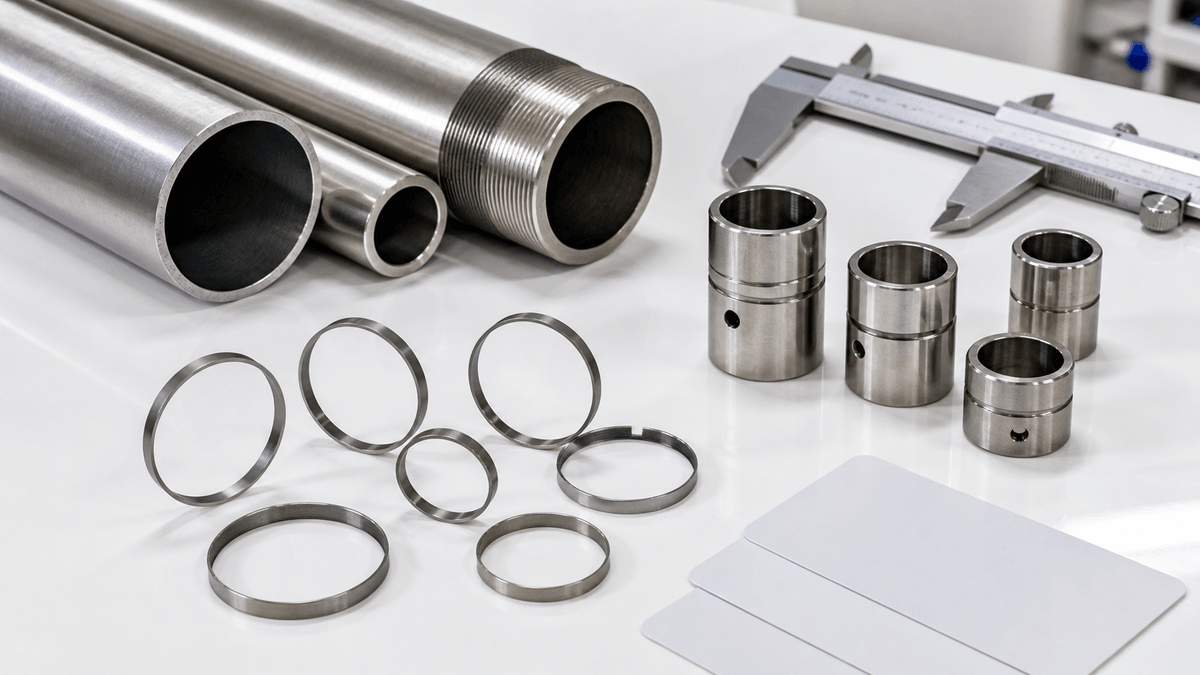
The key feature of NiTiNb is wide transformation hysteresis. Conventional binary NiTi can have a much narrower gap between transformation ranges, which may make storage and installation less convenient for certain coupling designs. Research on NiTiNb pipe joints describes NiTiNb alloys as having much larger transformation temperature hysteresis than conventional binary NiTi, enabling pipe joints to be stored and transported at room temperature after suitable processing.
GEE SMA product notes state that wide-hysteresis NiTiNb expanded the range of couplings and fasteners. The notes also describe a deformation condition around Ms + 30 degrees C and a critical deformation range around 16 to 20 percent for improving martensite stability, increasing hysteresis, and maintaining recovery force. Those process-sensitive claims should be confirmed against the actual ring design and lot data, not treated as a universal catalog value.
GEE SMA's shape memory alloy product range is relevant because NiTiNb belongs in a different conversation from SE508 wire, actuator wire, or Copper NiTi orthodontic raw material.
The Product Is Usually a Ring or Coupling
In GEE SMA product language, NiTiNb appears most clearly in nitinol rings. The notes list models from TR04 to TR24 and position the product around fastening, coupling, and sealing. The public GEE SMA NiTiNb page lists product parameters including Ni, Nb, and Ti balance, transformation-temperature data, hysteresis greater than 150 degrees C, and recovery stress information for deformed conditions.
That product form matters. A NiTiNb ring is not purchased like straight wire. The buyer needs geometry, inner and outer diameter states, expansion condition, installation clearance, mating part material, required clamping force, thermal activation route, operating temperature, and whether disassembly or adjustment is part of the design. GEE SMA's supplier evaluation controls fit NiTiNb because the final function comes from material behavior and geometry together.
Expansion and Activation Are a Process Pair
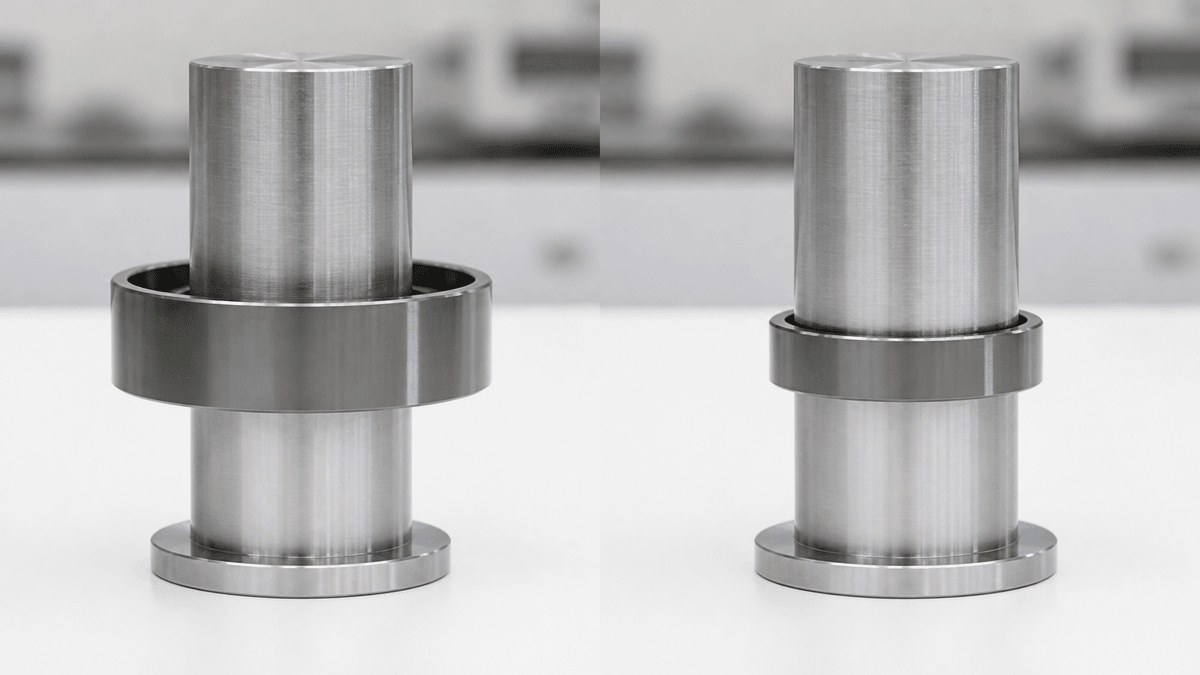
A NiTiNb coupling or ring is commonly expanded in a lower-temperature condition, installed over or inside the mating part, and then heated so it recovers and creates radial clamping pressure. GEE SMA product notes state that NiTiNb rings begin to recover around 60 to 75 degrees C and reach full clamping force around 90 to 115 degrees C in the described ring context. Those values should be treated as product-family guidance that must be verified for the selected model and expansion route.
The assembly process determines whether the ring creates reliable clamping. If the clearance is too large, the ring may not contact the mating part at the right time. If the wall thickness or width is mismatched, contact pressure can become uneven. Research on NiTiNb pipe joints emphasizes matching the dimensions of the SMA joint and pipe to obtain stable connection performance. GEE SMA's supplier evaluation controls are relevant when a buyer needs process discussion, not only a material quote.
Clamping Force Is Intrinsic but Still Must Be Designed
Shape memory clamping is attractive because the recovery force comes from the ring material itself after the proper deformation and heating route. GEE SMA product notes list benefits such as seamless 360-degree clamping pressure, joining and sealing dissimilar materials, repeatability, vibration and thermal cycling resistance, chemical resistance, and operator-insensitive assembly. These are useful product-positioning points, but the buyer should still validate them in the actual assembly.
Clamping force depends on ring geometry, expansion strain, heat treatment, transformation behavior, mating part stiffness, surface finish, temperature path, and tolerances. The strongest RFQ includes drawings for both the NiTiNb ring and the mating parts. GEE SMA's surface-control approach is relevant when sealing or clamping depends on clean contact surfaces.
Temperature Range Needs Clear Boundaries
GEE SMA product notes state that installed NiTiNb rings can maintain clamping force over a broad temperature range, and that deep cooling can loosen grip for disassembly or adjustment in the described product context. Such statements should be handled carefully because actual performance depends on geometry, mating materials, deformation route, and service conditions. A buyer should request product-specific data rather than assuming one temperature range covers every design.
For safety-critical couplings, the test plan should include installation temperature, activation temperature, operating temperature, thermal cycling, vibration, pull-off or pull-out force, leakage or sealing evaluation, and dimensional inspection. GEE SMA's thermal motion material controls help keep the conversation at the assembly-function level.
Do Not Confuse NiTiNb With NiTiFe
The product table places NiTiNb ring and NiTiFe pipe coupling near each other. They are related in application space but should not be merged into one material name. NiTiNb refers to nickel-titanium-niobium alloy behavior, while NiTiFe refers to nickel-titanium-iron materials used for specific coupling or pipe applications. If the drawing needs NiTiNb, the material line should say Ni-Ti-Nb, not only "nitinol coupling."
GEE SMA's nitinol wire and material capability helps buyers separate NiTiNb rings, NiTiFe pipe coupling, actuator wires, springs, and superelastic wire before quoting. Clean naming reduces the chance of receiving the wrong material family.
RFQ Checklist for NiTiNb
- State whether the request is for NiTiNb ring, coupling, clamping part, or another shape memory component.
- Provide ring model or drawing, expanded and recovered dimensions, width, wall thickness, and tolerance.
- Define mating part material, diameter, surface condition, installation clearance, and required clamping or sealing behavior.
- Specify expansion condition, activation temperature, operating temperature range, and expected thermal cycling.
- Ask for material composition, transformation behavior, recovery force or clamping evidence, and inspection records.
- Clarify whether disassembly, adjustment, vibration, shock, chemical exposure, or sealing proof is required.
NiTiNb is a strong candidate when wide hysteresis, room-temperature handling after expansion, and thermally activated clamping are central to the design. It should be specified as a ring or coupling system, not as a loose alloy word. GEE SMA can support NiTiNb ring and coupling discussions where material composition, deformation route, recovery temperature, clamping force, geometry, and inspection need to move together.