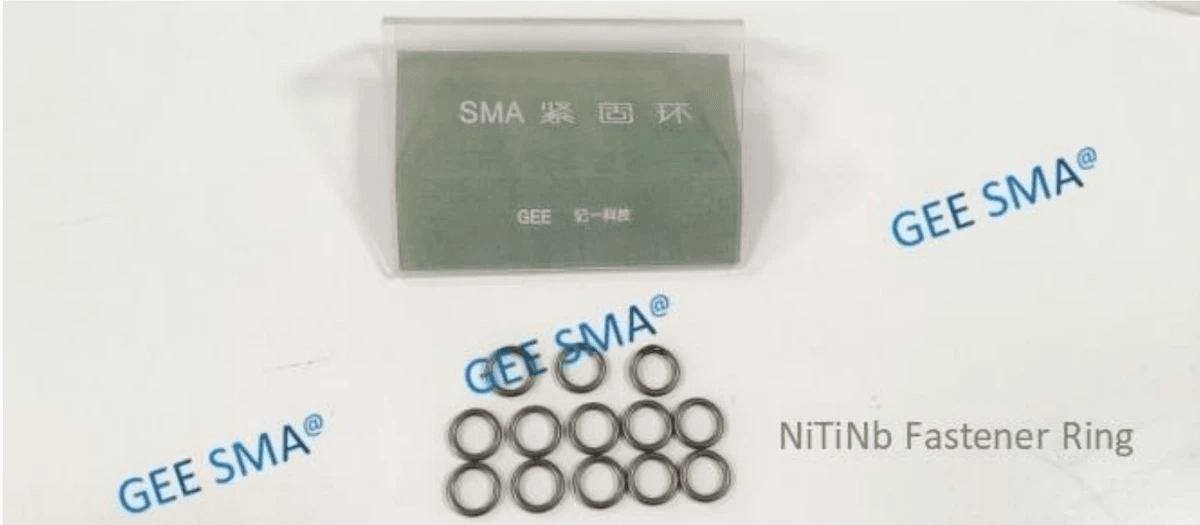
NiTiNb Ring
Nitinol rings are manufactured from various alloy formulations, each tailored for specific performance characteristics. Among these, the NiTiNb alloy is the most widely used.
NiTiNb alloy features a distinct deformation temperature (Ms + 30 °C) and a critical deformation range of 16%–20%. Within this range, deformation significantly enhances martensite stability, increases phase transformation hysteresis, and ensures high levels of strain recovery and recovery force.
Fasteners made from NiTiNb alloy can be conveniently stored at room temperature, simplifying their use in engineering applications.
The development of wide-hysteresis NiTiNb alloys has significantly broadened the application scope of mechanical couplings and fasteners.
NiTiNb rings are commonly employed in electronic and mechanical systems, including connectors, sealing mechanisms, and clamping components. They deliver dependable performance across a wide temperature range from –60 °C to 300 °C.
The alloy starts to recover at approximately 60–75 °C and achieves full clamping force between 90 °C and 115 °C. Once engaged, NiTiNb rings maintain their clamping force from –65 °C to +300 °C. For removal or adjustment, cooling the components below –120 °C using liquid nitrogen will release their grip.
Specifications
Table 1: NiTiNb Ring Finished Product Specifications NO Model Min diameter of ring (delivery status) A1 (mm) Max diameter of ring (after heat-shrinkage) A2 (mm) Min diameter of ring (delivery status) B1 (mm) Max diameter of ring (after heat-shrinkage) B2 (mm) Diameter of wires (mm) 1 TR04 10.084 9.672 10.566 10.109 1.854 ± 0.127 2 TR05 11.684 11.176 12.167 11.633 1.854 ± 0.127 3 TR06 13.284 12.675 13.919 13.284 1.854 ± 0.127 4 TR07 14.884 14.199 15.392 14.681 1.854 ± 0.127 5 TR08 16.510 15.748 17.018 16.231 1.854 ± 0.127 6 TR10 18.986 18.097 19.504 18.491 1.854 ± 0.127 7 TR12 23.165 22.022 23.647 22.904 1.854 ± 0.127 8 TR14 26.416 25.095 26.924 25.578 1.854 ± 0.127 9 TR16 29.035 27.434 29.543 28.194 1.854 ± 0.127 10 TR18 33.045 31.344 33.528 31.801 1.854 ± 0.127 11 TR20 35.663 33.937 36.147 34.663 1.854 ± 0.127 12 TR22 39.192 37.260 39.675 37.807 2.236 ± 0.179 13 TR24 42.494 40.310 42.951 40.767 2.236 ± 0.179 Product Parameters
Table 2: Product Parameters Alloy Composition Nickel (nominal ratio) 48.3 ± wt.% Niobium (nominal ratio) 14.67 wt.% Titanium balance Oxygen + Nitrogen + Carbon max. 0.070 wt.% Transformation Temperature Af Fully Annealed Condition Mf=–110°C, Ms=–90°C, As=–55°C, Af=–35°C Active transformation As’=60°C, Af’=80°C (–60°C, 16% deformation)
As’=70°C, Af’=82°C (–60°C, 18% deformation)
As’=72°C, Af’=89°C (–60°C, 20% deformation)Hysteresis (As–Ms) > 150°C Physical Properties Melting Point 1150°C Density 6.70 g/cm³ Mechanical Properties (Fully Annealed Condition) Ultimate Tensile Strength (UTS) Rm min. 800 MPa Yield Strength Rp min. 450 MPa Total Elongation min 10% Reduction of Area min 20% Shape Memory Properties Maximum Recovery Stress 436 MPa (–60°C, 16% deformation) NiTiNb Ring & NiTiFe Pipe Coupling

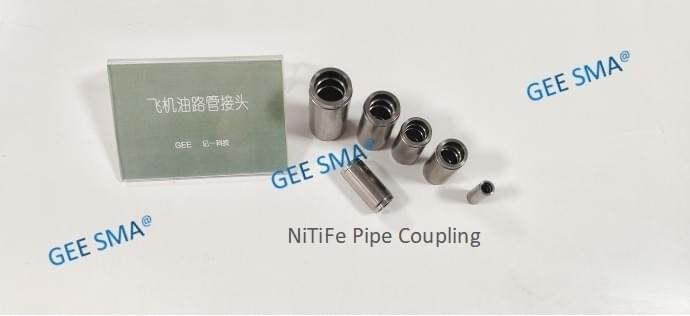
NiTiFe Pipe Coupling

NiTiNb Rings