

Introduction: Electrical Performance Starts With the Wire
The phrase guide wire electrical can point to several design questions at once. In some projects, engineers are evaluating an electrically active guidewire used with radiofrequency energy or sensing. In others, they are concerned about how the guide wire behaves when it is near energized instruments, imaging systems, test fixtures, or conductive pathways inside a catheter assembly. Whatever the application, the material at the center of the device has a direct effect on flexibility, torque response, dimensional stability, surface processing, and risk control.
For many minimally invasive devices, nitinol is chosen because it can bend through tortuous anatomy and recover shape better than many conventional metals. A guidewire that must pass through a curved path, maintain support, and respond predictably to rotation needs a core material that tolerates repeated deformation. When electrical behavior is added to the design conversation, engineers also need to think carefully about insulation, exposed conductive regions, surface finish, heat generation, and how the wire will be tested.
This article explains guide wire electrical considerations from a material and component perspective. It focuses on what medical device teams should consider when selecting nitinol wire for guidewire development, how electrical use cases change design priorities, and why early supplier conversations can reduce late-stage surprises.
What Does Guide Wire Electrical Mean in Device Development?
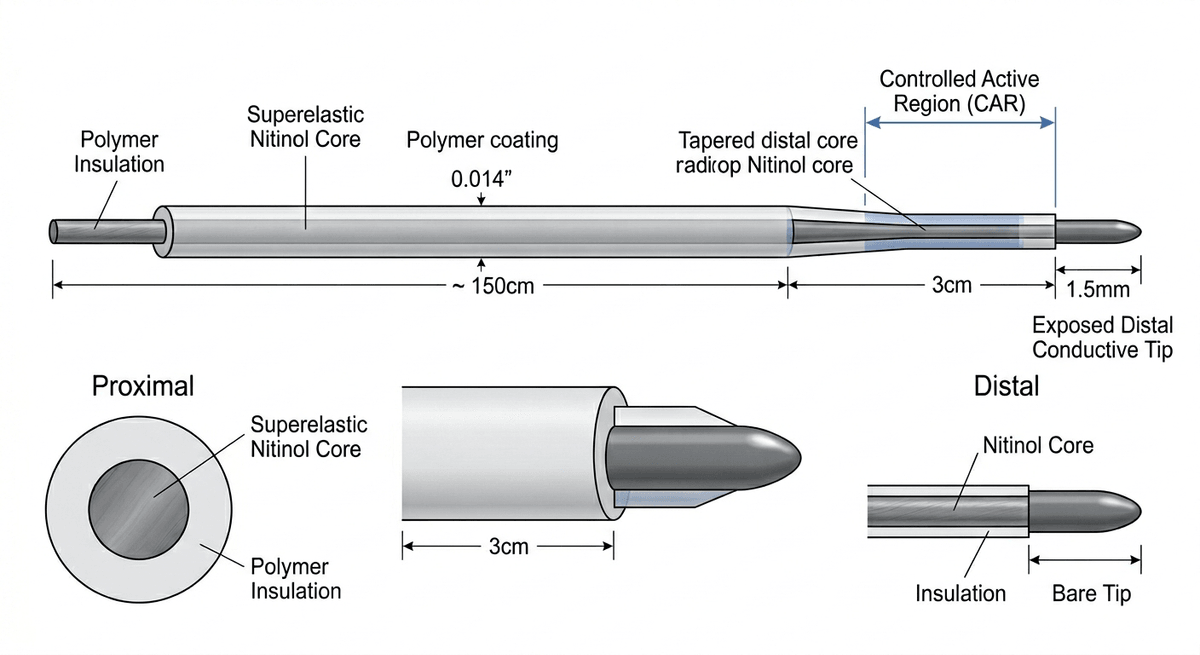
Guidewire projects are not all electrically active. Many guidewires are purely mechanical navigation tools. They are designed to help physicians access vessels, cross lesions, support catheter delivery, or exchange devices. In these cases, electrical considerations may still appear in manufacturing, inspection, and compatibility testing, but the guidewire itself is not intended to deliver energy.
An electrical guide wire, by contrast, may be part of a system that intentionally conducts current, transmits a signal, or works with radiofrequency energy. Transcatheter electrosurgery is one high-profile example. The American College of Cardiology describes procedures in which high-frequency current is delivered through an insulated guidewire so tissue can be traversed or lacerated during specialized structural heart interventions. This type of use is highly application-specific and requires rigorous design controls, insulation strategy, and clinical risk assessment.
Between those two categories is a large middle ground. Engineers may use the phrase guide wire electrical when they are investigating conductive cores, laser-welded joints, conductive coatings, electrical continuity testing, leakage current, dielectric breakdown of polymer coatings, or the heating behavior of small metal wires under current. For OEM teams, the first step is to define the electrical role clearly: is the wire a conductor, a passive mechanical member near electrical energy, or a component that must remain electrically isolated?
Why Nitinol Is Common in Modern Guidewire Designs

Nitinol, a nickel-titanium shape memory alloy, is widely used in guidewire and catheter-related applications because of its superelastic behavior and kink resistance. GEE SMA's overview of nitinol guidewire technology explains how this material supports navigation through complex vascular pathways. The same GEE SMA nitinol wire page lists diameters from 0.0020 inch (0.05 mm) to 0.2755 inch (7.0 mm), with options for straight lengths, customer-specified spools, custom profiles, black oxide surfaces, and mechanically polished surfaces.
Commercial guidewire examples show why the material matters. Medtronic's Nitrex guidewire is positioned around a nitinol core for use in peripheral and coronary vasculature, with different diameters and tip styles. Galt Medical's TORX guidewire page highlights a nitinol kink-resistant core, torque transmission, support, and a radiopaque gold tip. These product pages are not specifications for every project, but they show the market's consistent interest in kink resistance, flexibility, torqueability, and visualization.
For an electrical or electrically adjacent guidewire, those same mechanical properties still matter. A conductor that cannot track through the anatomy, a wire that kinks during placement, or a core that loses torque response after bending will create problems even if the electrical circuit works on the bench. Material selection cannot be separated from the full device use case.
Electrical Design Factors Engineers Should Define Early

The most important early question is whether current should travel through the nitinol core. If the answer is yes, the team must define the current level, frequency, duty cycle, exposed active length, return path, and worst-case heating conditions. Nitinol is conductive, but it is not selected only for conductivity. It is selected because its mechanical behavior solves access and navigation problems. Electrical performance must therefore be designed around the material's actual properties, surface state, geometry, and interface points.
Insulation is the next major decision. In an energized guidewire, the coating or polymer jacket often determines where energy can and cannot go. A small defect, thin spot, scratch, or poorly controlled transition can change the active electrical area. Designers should think about coating adhesion, bend durability, dielectric strength, abrasion resistance, and how the coating behaves after sterilization and simulated use. If the distal tip is intentionally exposed, the geometry of that exposed region should be controlled as tightly as any other functional feature.
Thermal behavior is also central. Small wires can heat quickly, especially when current density is high or contact conditions vary. Engineers should evaluate expected and abnormal conditions, including dry bench testing, tissue contact, saline environments, and contact with other conductive components. A safe design is not only about average performance; it is about understanding edge cases.
Finally, electrical testing should be planned before the design is locked. Continuity testing, insulation resistance, dielectric withstand testing, coating inspection, and thermal mapping may all be relevant. The exact test program depends on intended use, regulatory pathway, and risk analysis, but the wire supplier can help by providing consistent incoming material and clear dimensional and surface expectations.
Mechanical Performance Still Controls Clinical Usability

Electrical features do not remove the need for familiar guidewire performance metrics. Trackability, steerability, tip flexibility, torque response, radiopacity, and support remain central to device usability. A computational study of nitinol guidewires in tortuous paths found that guidewires can show lag and whip in torque response, and that material behavior affects performance under cyclic loading. For device developers, this reinforces a practical point: bench electrical success is not enough if the guidewire cannot transmit rotation predictably after traveling through a curved pathway.
Nitinol guidewire selection affects these behaviors through alloy type, transformation temperature, diameter, straightness, surface condition, and processing history. A wire that is excellent for a simple actuator may not be right for a guidewire core. A guidewire application may need a narrow balance: flexible enough to navigate, stiff enough to support delivery, resistant to kinking, and consistent across lots.
This is where early component-level collaboration becomes useful. Instead of treating nitinol wire as a commodity, medical device engineers should define the functional envelope: diameter, profile, surface finish, expected strain, temperature environment, coating compatibility, joining process, and inspection plan. A supplier that understands nitinol processing can help translate those requirements into a practical material specification.
Surface Finish, Coatings, and Interfaces

Surface condition is especially important in guide wire electrical design because surface features influence both mechanical integration and electrical behavior. Black oxide, mechanically polished, centerless ground, etched, or coated surfaces can behave differently during bonding, coating, welding, and electrical testing. Even when the nitinol itself is not the primary conductor, the surface can affect how adjacent materials adhere or how defects are detected.
For guidewire components, coatings may be selected for lubricity, insulation, biocompatibility, or device compatibility. A hydrophilic coating may improve navigation, while an insulating polymer may define the active electrical path. These coatings need to survive bending, torque, friction, and handling. At transitions such as distal tips, proximal connectors, weld zones, marker bands, or coil interfaces, the design should avoid sharp discontinuities that create stress concentrations or electrical weak points.
GEE SMA lists black oxide and mechanically polished nitinol wire options across defined diameter ranges. For OEM teams, this gives a starting point for supplier discussion. The right surface is not simply the cleanest or brightest surface; it is the surface that supports the next process and the final device function.
How to Specify Nitinol Wire for an Electrical Guidewire Project
A strong specification starts with geometry. Define nominal diameter, tolerance, length form, straightness, profile shape, and any special distal or proximal requirements. GEE SMA's wire capabilities include round wire as well as custom wire forming for rectangles, squares, and special profiles, which may be relevant for nonstandard component architectures.
Next, define the alloy and mechanical condition. Superelastic nitinol may be appropriate when recovery after bending is central to the design. Shape memory behavior may matter in other component concepts. Transformation temperature should be discussed because it influences whether the material behaves as intended at room temperature, body temperature, or elevated process temperatures. If an electrical process or use condition creates heat, transformation behavior becomes part of the design review rather than a background detail.
Surface and cleanliness requirements should follow. Specify whether the wire should be black oxide, mechanically polished, or prepared for another downstream surface process. If the wire will be coated, welded, soldered, crimped, or mechanically captured, the supplier should understand those downstream steps. The same wire may need different preparation depending on whether it will become a passive core, an energized conductor, or an actuator-like element.
Finally, define documentation and lot control expectations. Medical device development teams usually need traceability, consistent packaging, dimensional inspection, and clear communication about process changes. The more demanding the guide wire electrical application, the more important material consistency becomes.
Supplier Selection: What OEM Teams Should Ask
When evaluating a nitinol supplier for guidewire development, ask questions that connect material capability to device risk. What diameter range can the supplier hold consistently? What tolerances are available for fine wire? Which alloy families are offered? What surface conditions are standard, and which require custom development? Can the wire be supplied on spools or in straight lengths? How does the supplier package fine wire to reduce handling damage?
GEE SMA's public material indicates a focus on nitinol raw materials, actuator wires, and wire products, including SE alloys, LSE alloys, SM alloys, and other NiTi alloy options upon request. The company also presents itself as an experienced nitinol-focused manufacturer. For an OEM team, that positioning is useful when the project requires material discussion rather than simply purchasing an off-the-shelf finished guidewire.
The best supplier conversation is not limited to price and lead time. It should include functional intent, critical dimensions, surface finish, test methods, and the downstream processes that could change wire performance. For electrical guidewire projects, the supplier does not replace device-level design verification, but it can help reduce material variation and support a more controlled development path.
Conclusion
Guide wire electrical design is a multidisciplinary problem. It touches conductivity, insulation, heating, coating integrity, torque response, kink resistance, and material consistency. Nitinol is attractive because it can provide the flexibility and recovery required for complex guidewire paths, but those advantages must be matched with the right geometry, surface condition, transformation behavior, and quality expectations.
For medical device engineers and sourcing teams, the practical takeaway is simple: define the electrical role of the wire early, then select the nitinol material around both electrical and mechanical requirements. A guidewire that conducts energy, resists kinking, tracks smoothly, and passes verification testing depends on disciplined choices at the material level.
GEE SMA can be considered as a nitinol material and component partner for teams evaluating Niti alloy wire for guide wire applications, shape memory alloy wire, custom wire profiles, and surface finish options for guidewire-related development. For projects involving regulated medical devices, final design, validation, clinical use, and regulatory claims must remain under the OEM's formal development and quality systems.