

Guidewire Performance Starts Before Assembly
A nitinol guidewire is often discussed as a finished clinical tool, but its performance starts much earlier with the wire material. Flexibility, kink resistance, recovery, torque response, coating compatibility, and surface reliability all depend on decisions made before the guidewire is assembled. That is why medical device teams should specify nitinol guidewire material as an engineered input, not as a generic wire purchase.
GEE SMA product notes describe nitinol guidewire material as flexible nickel-titanium shape memory alloy wire, with ASTM F2063 used as a key medical-material reference. The notes list alloy families such as SE508, SE508 ELI, SE510, LSE5065, and LSE507ELI. They also identify SE508 and SE508 ELI as especially relevant for guidewire production. Those details help buyers move from "nitinol wire" to a more useful material conversation.
GEE SMA supplies nitinol wire, actuator wire, springs, sheets, tubes, and related shape memory alloy products. For guidewire-related work, the company should be viewed as a material and component partner. The finished device manufacturer remains responsible for guidewire design, validation, regulatory submissions, and finished-product claims.
Why Superelastic Alloys Matter
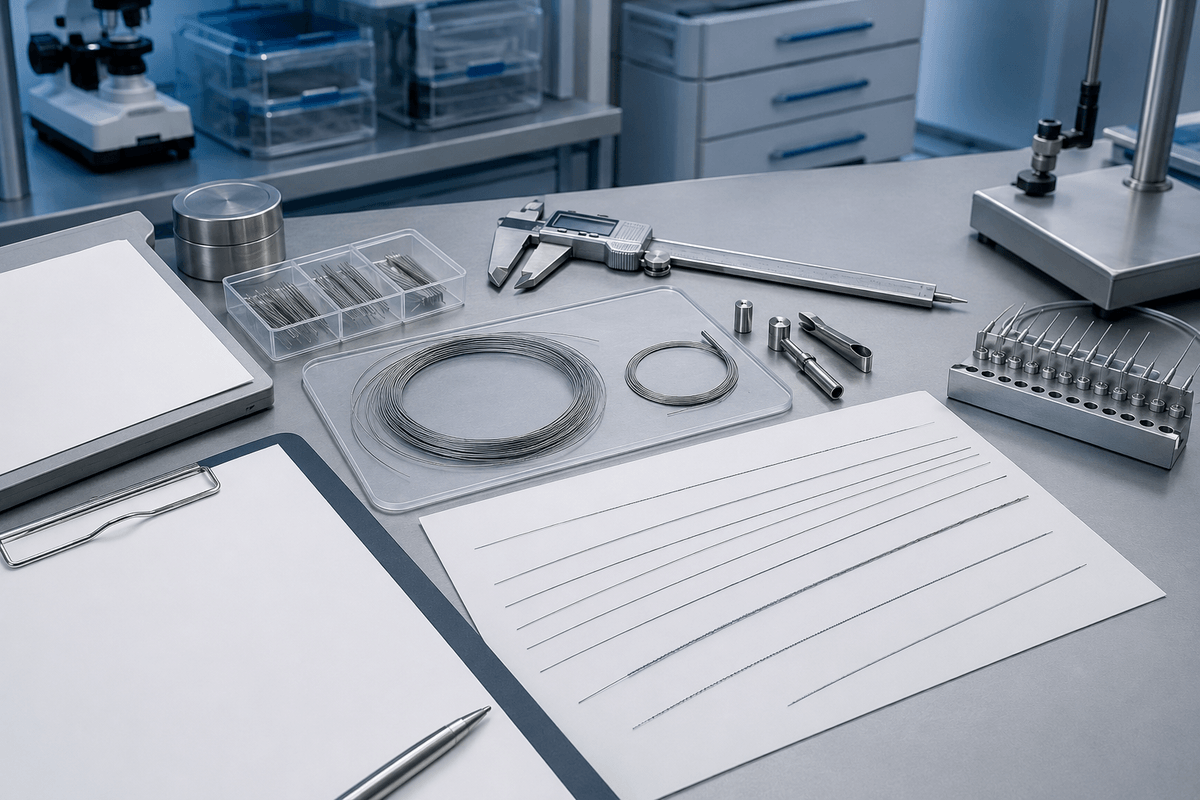
Guidewire cores are often asked to do several jobs at once. They need to navigate curved paths, resist permanent kinking, provide enough support for device delivery, and recover after bending. Superelastic nitinol helps because it can deform and recover within the right strain and temperature window. This is the reason SE alloy families appear so often in guidewire material discussions.
GEE SMA's nitinol guidewire technology article explains the relationship between nitinol wire behavior and device navigation. In the product notes, SE is used as an abbreviation for superelasticity, and the guidewire material section points to SE508, SE508 ELI, SE510, LSE5065, and LSE507ELI as possible alloy codes.
The important point is that alloy code should match the intended guidewire behavior. A soft, low-superelastic feel may be useful for one design, while stronger recovery may be needed for another. The wire's final condition depends not only on chemistry, but also on cold work, heat treatment, straightening, and surface preparation.
Diameter Is a Design Variable
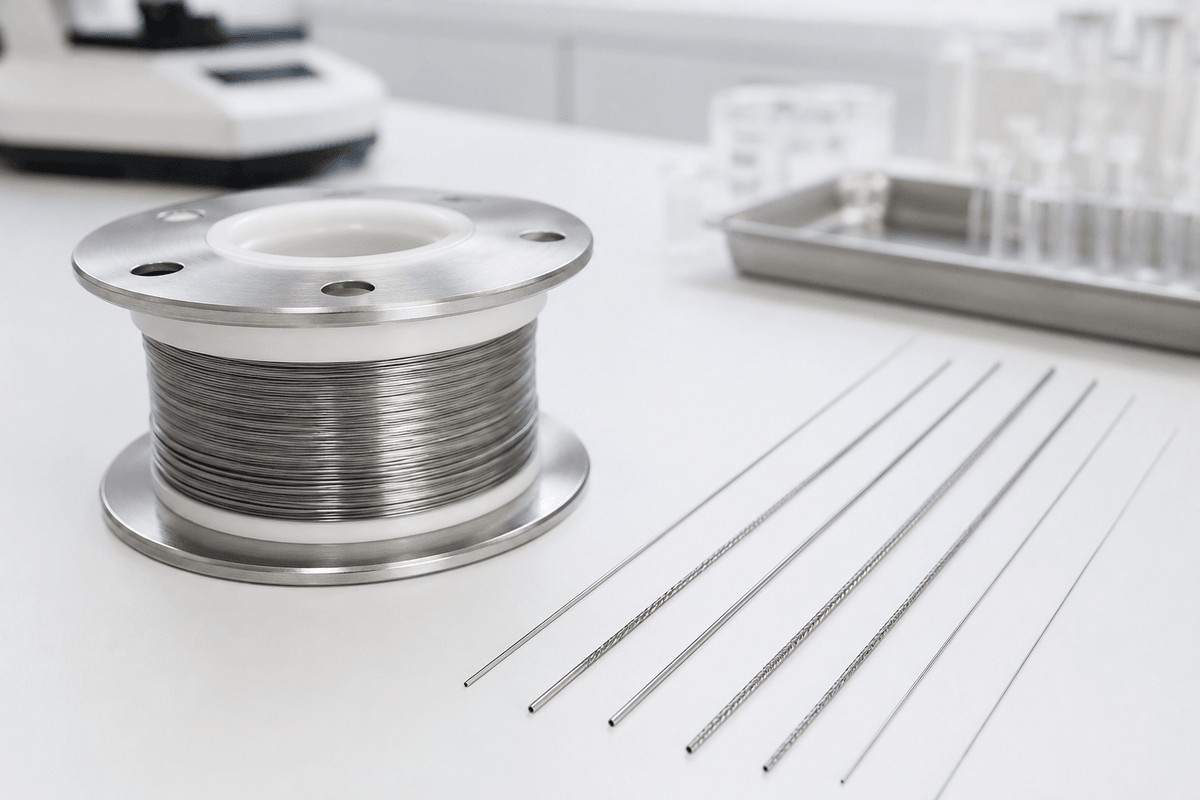
GEE SMA product notes list nitinol guidewire-related diameters from 0.05 mm, or 0.002 inch, and up. For guidewire-related applications, the notes identify 0.20 to 0.90 mm, or 0.008 to 0.035 inch, as a common diameter range. These values are useful for early sourcing conversations, but the correct diameter should come from the device architecture.
A smaller diameter may improve flexibility and access, but it can be more sensitive to handling, coating, and packaging. A larger diameter can provide support and pushability, but it may reduce flexibility. If the wire will be ground, tapered, coated, welded, or assembled with coils and markers, the starting diameter and tolerance must support the entire process route.
GEE SMA product notes also describe diameter tolerance categories for guidewire material. Instead of treating tolerance as a purchasing detail, engineers should connect it to device function. If a wire must fit through a coating process, fixture, coil, or catheter assembly, tolerance can become a functional requirement.
Cold Drawn or Straight Annealed
Delivery condition deserves careful discussion. GEE SMA product notes list cold drawn and straight annealed delivery conditions for nitinol guidewire material. A cold drawn wire is a cold-worked material that may be intended for later heat treatment or processing. A straight annealed wire has gone through straightening heat treatment and can be supplied in a more usable superelastic condition.
The choice depends on the customer's process. If the guidewire design requires further shaping, heat treatment, or custom processing, cold drawn material may be appropriate. If the design needs straight superelastic wire for downstream assembly, straight annealed wire may be more suitable. The supplier should understand the next manufacturing step before quoting.
GEE SMA's custom nitinol wire forming content is relevant when a guidewire-related concept needs more than a straight wire. Forming, heat setting, and surface condition can all affect final performance.
Surface Finish Is Part of the Specification
Surface finish affects more than appearance. GEE SMA product notes list black oxide, light oxide, and mechanically polished surfaces for guidewire-related nitinol material. Black oxide is described as a drawing-process surface. Light oxide may appear brown or blue and can be relevant when later electropolishing or etching is expected. Mechanically polished wire provides a metallic surface.
Guidewire-related components may later receive coatings, adhesives, marker bands, grinding, or other assembly operations. The surface supplied by the wire manufacturer must be compatible with those steps. A surface that works for heat setting may not be the final surface for a patient-contacting component. A polished surface may support inspection or coating, but the finished device still needs its own verification.
For medical device teams, GEE SMA's nitinol biocompatibility article is a useful reminder that final surface condition, corrosion behavior, nickel release, and biological evaluation depend on the finished device, not only on the raw wire.
From Sample Wire to Device Program
Early nitinol guidewire samples should answer focused questions. Does the diameter support the target flexibility? Does the selected SE alloy provide the desired recovery? Does the supplied surface survive the customer's grinding, coating, joining, or cleaning process? These questions are easier to solve at sample stage than after a full drawing, forming, or assembly route is already locked.
For small-diameter wire, even modest changes in cold work or straight annealing can alter feel. A sample that looks correct by size may still behave differently if the transformation temperature, plateau stress, straightness, or surface condition is not aligned with the intended guidewire design. This is why buyers should keep sample requests tied to a written specification instead of treating trial wire as a generic material.
Production planning should also consider lot control. If a guidewire program is moving from prototype to volume, the purchasing file should define alloy code, nominal diameter, tolerance, surface, delivery condition, package form, inspection documents, and any customer-specific handling requirements. That information gives the supplier a stable target and gives the buyer a clearer basis for incoming inspection.
Visual Quality and Clean Handling
GEE SMA product notes include visual expectations for guidewire-related material, such as freedom from kinks, bends, ripples, burrs, visible particulate, debris under magnification, and oxidation discoloration for polished surfaces. These details are easy to underestimate, but they matter. A kink or surface defect can affect downstream processing, coating quality, fatigue performance, and inspection results.
Handling and packaging should be part of the purchasing discussion. The product notes describe wire packaging on spools and in export cartons, with extra protection for larger quantities. For fine wire, spool control and surface protection are not only logistics. They help preserve the material condition that engineering teams are trying to specify.
When a medical device program moves from sampling to design verification, buyers should define labeling, lot identity, packaging, and incoming inspection requirements. A wire that performs well can still create problems if it is scratched, kinked, or mixed during handling.
Documentation for Medical Programs
Documentation should follow the stage of the project. For early feasibility, basic size and material information may be enough. For medical development, the documentation package may need to include chemical composition, diameter and tolerance, mechanical and superelastic properties, transformation temperature testing, and lot traceability.
GEE SMA product notes refer to ASTM F2516 for tension testing, ASTM F2004 for transformation temperature by thermal analysis, and ASTM F2082 for bend and free recovery transformation temperature testing. They also reference ASTM F2063 for wrought nickel-titanium material used in medical devices and surgical implants. These standards help create a shared technical language, but they do not replace finished-device validation.
GEE SMA's ASTM F2063 SE nitinol material article can help buyers connect standard language to product form. The OEM still needs to define the guidewire's finished geometry, coating, sterilization, biocompatibility, fatigue, and regulatory evidence.
Supplier Questions Before Sampling
- Which alloy code best fits the guidewire function: SE508, SE508 ELI, SE510, LSE5065, or another option?
- What diameter, tolerance, straightness, and length form are required for downstream assembly?
- Should the material be cold drawn, straight annealed, or supplied for customer heat treatment?
- Which surface finish supports coating, polishing, etching, or final inspection?
- What documentation is needed for chemistry, mechanical properties, transformation temperature, and lot traceability?
- How will the wire be packaged to avoid kinks, scratches, and surface contamination?
These questions keep the guidewire discussion grounded in material behavior. They also help prevent the common mistake of selecting nitinol guidewire material by diameter and price alone.
What Not to Assume
Do not assume that every nitinol wire sold in a guidewire diameter is ready for the same use. Medical guidewire development involves design validation, process validation, biological evaluation, sterilization strategy, and regulatory work beyond the raw material order. The material supplier can support the wire specification, but the finished device manufacturer remains responsible for the finished guidewire design and claims.
Do not assume that a brighter surface is always better. A mechanically polished surface may be useful for inspection or later finishing, while oxide surfaces may be acceptable for intermediate processing. The right choice depends on the downstream route.
Do not assume that ASTM F2063 alone defines every feature the buyer needs. It is a strong starting standard for wrought nickel-titanium shape memory alloy material, but a real purchase order usually also needs diameter tolerance, straightness expectations, surface condition, transformation temperature, mechanical data, certificate format, and packaging instructions.
Bottom Line
Nitinol guidewire performance depends on material choices made before the finished device is assembled. Alloy code, diameter, delivery condition, surface finish, documentation, and packaging all affect how the wire behaves during development and production.
For OEM teams evaluating guidewire-related nitinol material, GEE SMA can support material-level discussion around SE alloy options, superelastic wire, surface condition, and custom processing. The strongest path is to define the guidewire function first, then build the wire specification around that function.