

The Wrong First Question
Nitinol wire is often searched as if it were a simple metal product: find a diameter, ask for a price, place an order. That approach can work for a basic demonstration sample, but it is risky for engineering work. Nitinol is a nickel-titanium shape memory alloy, and its useful behavior depends on alloy family, transformation temperature, cold work, heat treatment, surface condition, straightness, packaging, and final use.
The better first question is: what job must the wire do? A wire used as a guidewire core is not the same as a wire used as a thermal actuator. A wire that will be formed into a snare or loop is not the same as a wire that will be polished and assembled into a medical device. A wire for educational shape memory demonstrations may not need the same documentation as wire for an OEM development program.
GEE SMA supplies nitinol wire, actuator wire, springs, sheets, tubes, and custom forms. For buyers, the value of a nitinol-focused supplier is not only material availability. It is the ability to translate a broad request into a useful wire specification.
Start With the Wire Function

Nitinol wire can support several different functions. In superelastic applications, the wire may need to bend and recover without permanent kinking. In shape memory applications, it may need to move when heated through a defined transformation range. In medical device development, it may need a controlled surface, traceable material, and documentation. In industrial or consumer mechanisms, it may need repeatable force, compact motion, or thermal response.
GEE SMA's shape memory alloy products page explains the broad behavior behind shape memory and superelastic materials. The product classification notes for GEE SMA place nitinol wire as a core product family and connect it with related buyer searches such as buy nitinol wire, nitinol wire for sale, nitinol wire price, nitinol guidewire, superelastic nitinol wire, shape memory nitinol wire, copper NiTi wire, and nitinol flat wire.
Those related searches are useful because they show how broad the category is. A buyer searching for "nitinol wire" may need a medical guidewire material, a shape memory actuator wire, orthodontic copper NiTi wire, fishing wire, flat wire, or a custom profile. The article should not collapse all of those needs into one product.
Diameter Is Only the Visible Dimension
Diameter matters, but it is not the whole specification. GEE SMA product notes list nitinol guidewire-related wire diameters from 0.05 mm, or 0.002 inch, and up. For guidewire-related applications, the notes identify 0.20 to 0.90 mm, or 0.008 to 0.035 inch, as common diameter territory. Those numbers help buyers frame early conversations, but the actual diameter should come from the component function.
A fine wire may support flexibility and compact packaging, but it may also be more sensitive to handling damage. A larger wire may provide more support or force, but it may reduce flexibility. If the wire will be heat set, coated, crimped, welded, or formed, the downstream process can also affect diameter tolerance and surface choice.
For medical and guidewire-related projects, diameter should be paired with straightness, tolerance, surface condition, mechanical behavior, and packaging. A wire can be the right nominal size and still be wrong for the application if it arrives with the wrong surface, delivery condition, or transformation behavior.
Alloy Code and Behavior Must Match
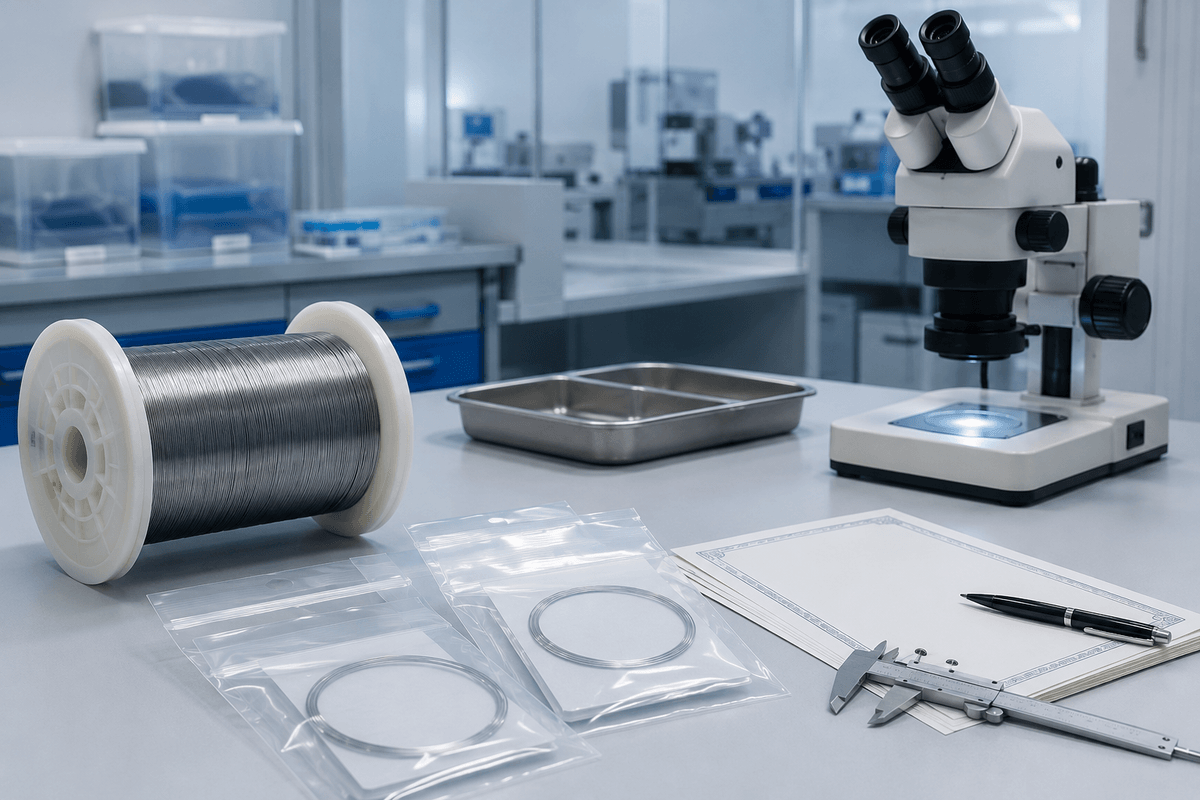
Nitinol wire buyers should ask which alloy family fits the job. GEE SMA's product notes for medical guidewire material list alloy codes including SE508, SE508 ELI, SE510, LSE5065, and LSE507ELI, with SE indicating superelastic behavior. They also describe SE508 and SE508 ELI as especially relevant for guidewire production. This kind of detail matters because "nitinol" is not one universal wire.
SE508 is widely discussed as a binary superelastic nickel-titanium alloy. GEE SMA's product notes describe SE508 as a 50.8 atomic percent nickel alloy family suitable for superelastic applications at room temperature or body temperature, depending on processing. They also list SE508 forms such as wire, flat wire, rod, sheet, plate, foil, and strip. For a wire buyer, this reinforces a practical point: alloy selection and product form must be considered together.
Transformation temperature is also important. GEE SMA's notes for guidewire-related material list an Active Af range of 0 to 35 degrees C, while SE508 notes include typical Active Af ranges that depend on heat treatment. A buyer should not treat these values as a universal promise for every wire order. They should be discussed as part of the material specification and confirmed for the intended product condition.
Cold Drawn or Straight Annealed?
Delivery condition is one of the details that can quietly change the project. GEE SMA's product notes describe nitinol guidewire delivery conditions such as cold drawn and straight annealed. A cold drawn wire is a cold-worked product that may be ready for later heat treatment, while a straight annealed wire has been processed to support straightness and superelastic behavior. The right condition depends on what the customer will do next.
If the customer plans to shape set the wire, a cold-worked condition may be useful. If the wire must be used in a straight, superelastic condition, straight annealed material may be more appropriate. If the wire will be formed into a loop, snare, basket, or custom profile, the team should discuss forming and heat-setting needs before ordering.
This is where GEE SMA's custom nitinol wire forming content becomes relevant. A custom shape is not just a bent wire. It can require a controlled combination of cold work, forming, heat treatment, surface management, and inspection.
Surface Finish Is Not Cosmetic
Surface finish is a performance variable. GEE SMA's product notes describe black oxide, light oxide, and mechanically polished nitinol wire surfaces. Black oxide is described as a black drawing-process surface. Light oxide may appear brown or blue and may be selected for medical device-related work where later electropolishing or etching is expected. Mechanically polished wire provides a metallic shiny surface.
The correct surface depends on downstream processing and final use. A surface that is acceptable for early shape setting may not be the final surface for a medical component. A polished wire may be useful when appearance, inspection, friction, or downstream assembly matters. A wire that will be coated may need a surface that supports adhesion. A guidewire-related component may need surface consistency because defects can affect coating, fatigue, corrosion, or handling.
GEE SMA's nitinol biocompatibility article is relevant here because surface condition, nickel release, corrosion behavior, and final device evaluation are connected. A raw wire surface does not automatically establish finished-device biocompatibility.
Guidewire Use Needs Tighter Language
Nitinol guidewire applications are a major reason buyers search for nitinol wire, but the language should stay precise. GEE SMA's product notes describe nitinol guidewire as a flexible wire made from nickel-titanium shape memory alloy, with ASTM F2063 referenced for medical material expectations. They also include visual appearance expectations such as freedom from kinks, bends, ripples, burrs, visible particulate, and debris under magnification.
Those details matter because guidewire-related material must support navigation, recovery, and downstream assembly. GEE SMA's nitinol guidewire technology article explains why flexibility, kink resistance, torque response, and material consistency matter in guidewire development. A wire that looks acceptable in a simple sample may still need tighter controls for a medical device program.
It is also important not to overclaim. Supplying nitinol wire for guidewire development is not the same as selling a finished regulated guidewire. The OEM remains responsible for design controls, verification, validation, regulatory submissions, labeling, and clinical claims.
Documentation Should Follow the Risk
For simple experiments, a buyer may only need a sample description and basic dimensions. For medical device development, documentation needs become more serious. GEE SMA's product notes describe quality certificate content that can include chemical composition, diameter and tolerance, mechanical and superelastic properties according to ASTM F2516, fully annealed ingot transformation temperature measured by DSC according to ASTM F2004, and Active Af measured according to ASTM F2082.
That list is useful because it shows the difference between casual sampling and controlled material supply. A buyer should decide which documents are needed at each stage. Early feasibility material may not need the same package as design verification material. Production supply may require traceability, lot control, packaging records, and change communication.
GEE SMA's ASTM F2063 SE nitinol material article can help engineers connect material standards to wire, rod, bar, and tube discussions. Standards support the material conversation, but they do not replace finished device testing.
Packaging Protects the Wire
Fine nitinol wire can be damaged by poor handling. GEE SMA's product notes describe spool and standard export carton packaging for wire, with additional wooden boxes for larger quantities. They also describe wrapping spooled wire with soft paper strips and keeping box weight controlled. The exact packaging should be confirmed for each order, but the principle is important: packaging is part of material quality.
A kink, scratch, tight bend, or contaminated surface can create problems later. If the wire will be used in medical device development, packaging and labeling may also affect traceability and incoming inspection. Buyers should ask how spools are protected, how lots are separated, and whether handling instructions are needed for fine diameters.
For shipping, early sample orders and larger production quantities may require different arrangements. A buyer should not wait until after the material is made to discuss packaging, especially when surface condition and straightness matter.
Supplier Questions for a Better RFQ
- Is the wire intended for superelastic recovery, shape memory activation, guidewire development, actuation, spring force, or custom forming?
- What alloy code or behavior is required, such as SE508, SE508 ELI, SE510, or another family?
- What diameter, tolerance, straightness, and length form are needed?
- Should the wire be cold drawn, straight annealed, or supplied for later heat treatment?
- Which surface finish is appropriate: black oxide, light oxide, mechanically polished, or a downstream-finished condition?
- What documentation is required for chemistry, dimensions, mechanical properties, transformation temperature, and traceability?
- How should the wire be spooled, protected, labeled, and shipped?
These questions move the RFQ from "nitinol wire price" to a real engineering request. They also help the supplier identify whether the requested wire is standard, custom, or under-specified.
Bottom Line
Nitinol wire is a high-value material because it can provide superelastic recovery, shape memory behavior, compact force, and useful performance in demanding medical and industrial designs. But its value depends on the right specification. Diameter, alloy code, delivery condition, surface finish, transformation temperature, documentation, and packaging all matter.
For buyers evaluating nitinol wire, GEE SMA can support material and component-level discussions across superelastic wire, guidewire-related material, actuator wire, custom profiles, and surface options. Start with the function, then build the wire specification around it.