

Nitinol wire forming is often described as a bending job, but that is too simple for serious production. A formed nitinol component can depend on alloy chemistry, active Af, cold work, fixture design, heat setting, surface finish, and inspection. If any one of those inputs is treated casually, the final loop, hook, spring, basket, frame, or actuator element may recover differently from the drawing expectation.
The practical question is not only whether nitinol can be formed. It is whether the formed geometry will hold the intended shape, recover through the required temperature or load path, avoid surface damage, and remain consistent from lot to lot. That is why GEE SMA's custom nitinol wire forming capability matters when a buyer needs more than a straight wire coil.
Start With Wire Behavior Before Fixture Design
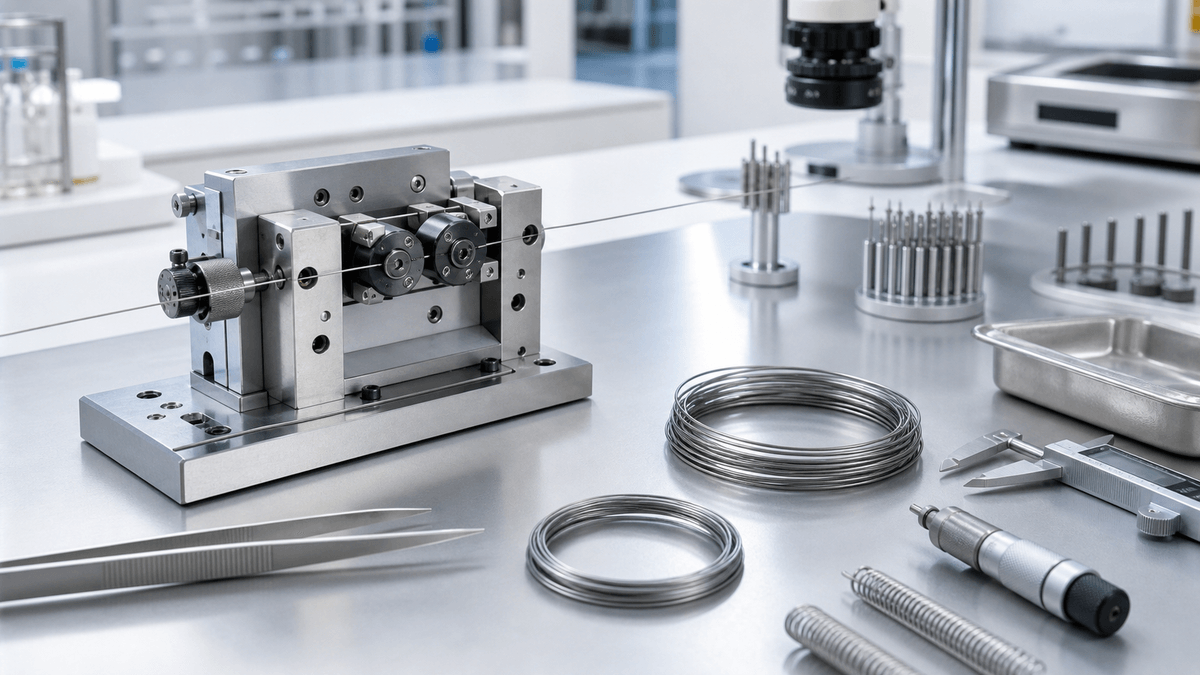
Before a forming fixture is built, the buyer should define what the wire must do after forming. Superelastic wire is usually selected when the part needs recoverable deformation during loading and unloading. Shape memory wire is selected when the part needs to recover a trained shape after heating through a defined transformation range. Both routes can use nitinol, but they do not ask the wire to behave in the same way.
GEE SMA product notes separate superelastic nitinol wire and shape memory nitinol wire by transformation-temperature behavior. For superelastic wire, the notes list cold drawn and superelastic straight annealed conditions, active Af values from -40 to 35 degrees C across alloy families, and ASTM F2516-style mechanical behavior. For shape memory wire, the notes list active Af ranges from 20 to 110 degrees C and alloy codes including binary NiTi and Copper NiTi families. Those details should be set before the forming route is chosen.
For teams still comparing wire families, GEE SMA's nitinol wire production range gives the sourcing conversation a stronger base: diameter, alloy code, surface, transformation temperature, and delivery condition are connected decisions.
Forming Geometry Creates Local Strain
A nitinol wire drawing may look clean on paper while still creating high local strain at the tightest bend. Small radius bends, offset hooks, closed loops, spring ends, and three-dimensional forms can concentrate strain in a way that affects recovery, plateau behavior, fatigue life, and surface condition. This is especially important for fine wire because a small scratch or flattened point can become a functional weak spot.
The forming review should include bend radius, wire diameter, cross section, straightness, bend sequence, fixture contact, springback allowance, and whether the design needs one trained shape or a repeated actuation cycle. A prototype fixture may prove basic shape recovery, but production needs repeatable clamping, heating, cooling, removal, and inspection. GEE SMA's wire specification discipline is relevant here because price discussions should not come before geometry and material risk are understood.
Fort Wayne Metals describes nitinol product forms that include round wire, flat wire, shaped wire, and shape-set parts. That kind of product map reinforces a useful sourcing point: formed nitinol is not a commodity bend. It is a material process combined with geometry control.
Heat Setting Turns a Bend Into a Trained Shape
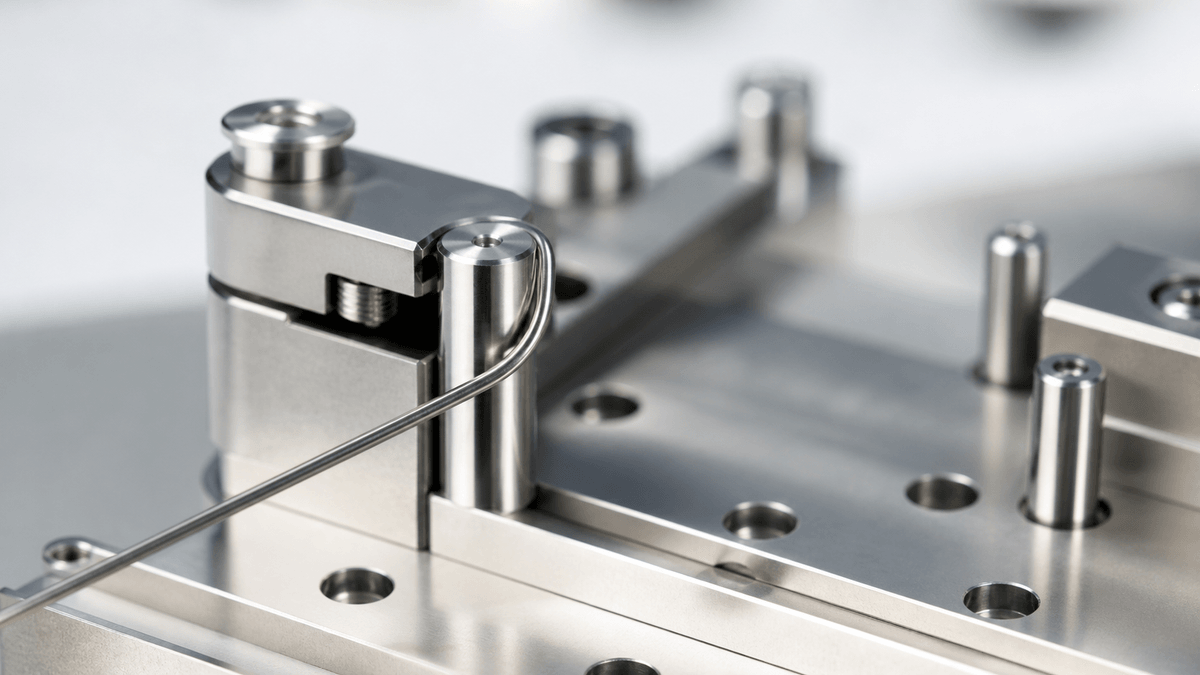
Shape setting is the step that gives nitinol a trained geometry. The wire is held in a fixture and heated under controlled conditions, then cooled and removed for inspection. The exact time, temperature, fixture material, atmosphere, quench or air-cooling route, and wire condition affect the result. A hotter or longer treatment may improve shape retention in one situation but change mechanical response or surface condition in another.
This is why the buyer should avoid giving only a finished drawing without describing the functional goal. A formed part for superelastic recovery may need a different route from a thermal actuator. A spring, basket, anchor loop, guidewire-related subcomponent, or small retention clip can each require a different balance of trained geometry and mechanical behavior.
GEE SMA's shape memory wire Af selection is a useful technical foundation when the formed wire must recover by heating. The active Af target should be tied to the actual use environment, not selected as a generic catalog value.
Surface Condition Cannot Be Repaired by Geometry
Forming can introduce tool marks, abrasion, localized oxide differences, or contact damage. Surface finish can also change during heat treatment. For nitinol, surface is not only cosmetic. It can influence friction, coating adhesion, corrosion behavior, nickel release evaluation, fatigue initiation, cleaning, and final inspection. This becomes more important when a formed part has internal corners or contact points that are difficult to polish later.
GEE SMA product notes list surface options such as black oxide, light oxide, polished bright, and mechanically polished surfaces for different nitinol wire families. The buyer should clarify whether the incoming wire surface is the final surface, an intermediate processing surface, or a starting point for later polishing, electropolishing, passivation, or coating. GEE SMA's nitinol surface-control approach is especially relevant when formed geometry and final surface quality interact.
For medical-device development, the OEM should evaluate the finished manufactured condition. FDA nitinol guidance emphasizes device-specific concerns such as composition, processing, surface characterization, corrosion, nickel release, and fatigue when applicable. A supplier can support material and component evidence, but final-device validation remains with the manufacturer.
SE508 and Shape Memory Grades Need Different Conversations
Many formed wire components start from SE508 because it is a common binary superelastic NiTi alloy. GEE SMA product notes describe SE508 as a widely used superelastic material form available as wire, flat wire, rod, sheet, plate, foil, and strip. For SE508 wire, active Af and thermomechanical history influence room-temperature and body-adjacent superelastic response. GEE SMA's SE508 wire controls are useful when the formed part still needs superelastic recovery after shape setting.
By contrast, shape memory wire may be selected for active movement. GEE SMA product notes list shape memory wire active Af from 20 to 110 degrees C, with tighter active Af control possible when the requirement is strict. If the formed part is an actuator, latch, thermal sensor, or muscle-wire element, the design must include heating, cooling, reset force, strain limit, and cycle expectations. GEE SMA's actuator wire capability fits projects where motion output is the reason for forming the wire.
Inspection Should Match the Function
Incoming inspection for straight wire may include diameter, surface, active Af, tensile behavior, and lot documentation. Formed wire inspection adds geometry. The team may need to inspect bend radius, angle, loop size, spring pitch, free length, trained shape, recovery after deformation, and final surface condition. For superelastic forms, ASTM F2516-style concepts such as plateau strength and residual elongation may be relevant. For transformation temperature, DSC or an equivalent thermomechanical method may be used depending on the specification.
The best inspection plan is built around the way the component can fail. A wire frame that must compress into a small space needs recovery and fatigue attention. A thermal actuator needs stroke, force, and reset behavior. A guidewire-related subcomponent needs surface and dimensional control. A small hook or clip may need shape retention and clean edges. One universal test cannot cover all of these cases.
GEE SMA's guidewire material specification controls show why wire behavior, surface, and documentation should stay connected when formed nitinol is used in demanding assemblies.
RFQ Checklist for Nitinol Wire Forming
- Share the drawing with wire diameter, tolerance, bend radius, trained shape, and critical dimensions.
- State whether the target behavior is superelastic recovery, shape memory actuation, spring force, or static formed geometry.
- Define alloy family, active Af target, delivery condition, surface finish, and quantity.
- Describe downstream steps such as coating, polishing, passivation, grinding, assembly, or sterilization exposure.
- Clarify inspection needs: geometry, active Af, surface, tensile or plateau behavior, fatigue screening, and documentation.
- Start with prototype lots when the shape has tight bend areas or the process window is not yet proven.
Nitinol wire forming succeeds when material behavior and geometry are treated as one process. The wire grade, active Af, surface, heat setting route, fixture design, and inspection plan all influence the final component. GEE SMA can support buyers who need nitinol wire, custom formed wire, shape memory wire, superelastic wire, and actuator-oriented material decisions with the discipline needed before production tooling is locked.