

Nitinol memory wire is often demonstrated as a strand that shortens when heated. A product needs the second half of the cycle: after power or heat is removed, the wire must cool, return to a deformable martensitic condition, and be extended for the next stroke. Unless the mechanism supplies that reset force and enough cooling time, repeatable motion will drift or stop.
The reset can come from a conventional spring, gravity, an external load, a compliant structure, or a second SMA element. GEE SMA's actuator wire options provide the active material, while the designer defines how the complete assembly travels in both directions.
Start With Both Ends of the Stroke
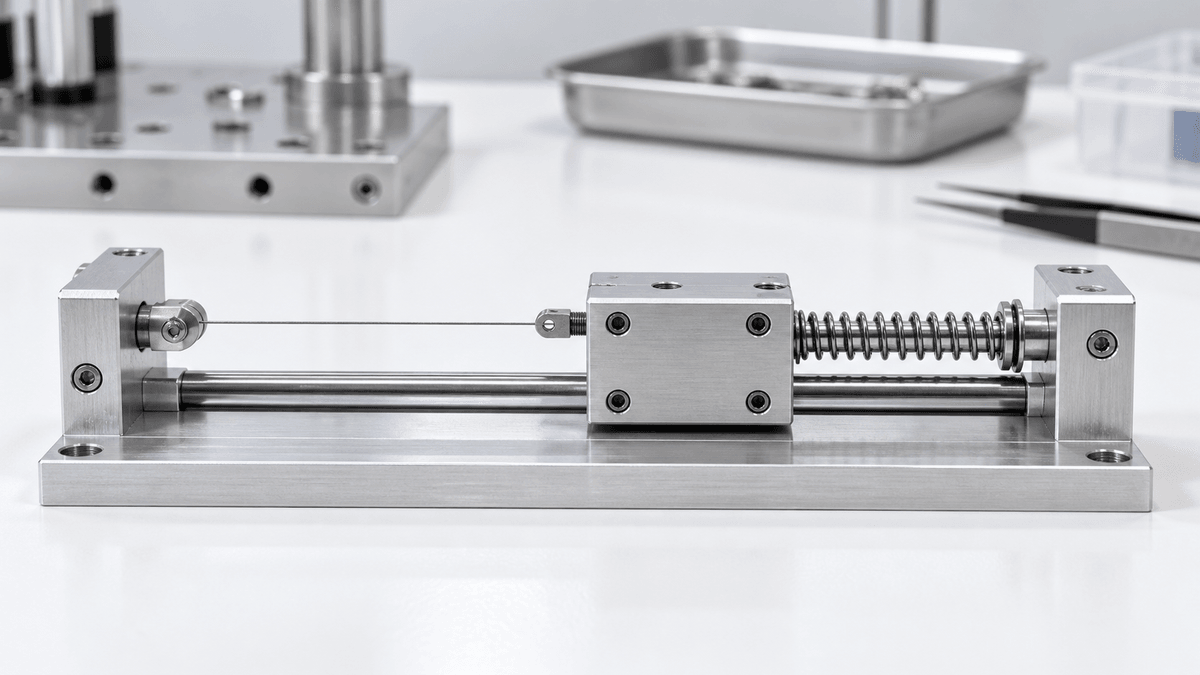
Define hot and cold positions before calculating wire length. For each position, record the external load, available package length, permissible preload, ambient temperature, and required response time. Stops should limit both over-contraction when hot and over-extension when cold. Without physical stops, a fault or unexpected load can push the material beyond its qualified strain.
A direct wire produces compact linear contraction, but its stroke is a percentage of active length. Pulleys, levers, and compliant flexures can transform that motion, although they also change force, friction, and local alignment. GEE SMA's custom component support is relevant when formed ends, frames, or integrated subassemblies must hold the active wire on its intended axis.
A Bias Spring Must Win at the Right Time
During heating, the SMA must overcome the bias spring and useful load. During cooling, the bias spring must extend the softened martensitic wire without exceeding the cold-state strain budget. Those force curves must overlap across the full travel, not merely at one midpoint.
A stronger bias may improve reset, yet it raises hot-state demand and can reduce available stroke. A weaker bias can leave residual displacement. Prototype tests should measure force versus position at hot and cold limits, including friction and tolerance extremes. The common bias architecture described in actuator research is simple, but its spring rate and preload remain system variables.
Antagonistic Wire Trades Simplicity for Control
Two opposing SMA wires can drive motion in both directions. One contracts while the other provides resistance and later becomes the active element. This arrangement can package well around a joint and can provide active return, but poor control can heat both sides unnecessarily or overstrain the cooling side.
Each wire needs independent current limiting, temperature awareness, and mechanical stops. The control logic should prevent simultaneous overload and allow adequate thermal recovery. GEE SMA's binary NiTi and copper-containing wire choices let prototypes compare transformation windows, but they do not remove the need to balance opposing forces.
Temperature Hysteresis Defines the Dead Band
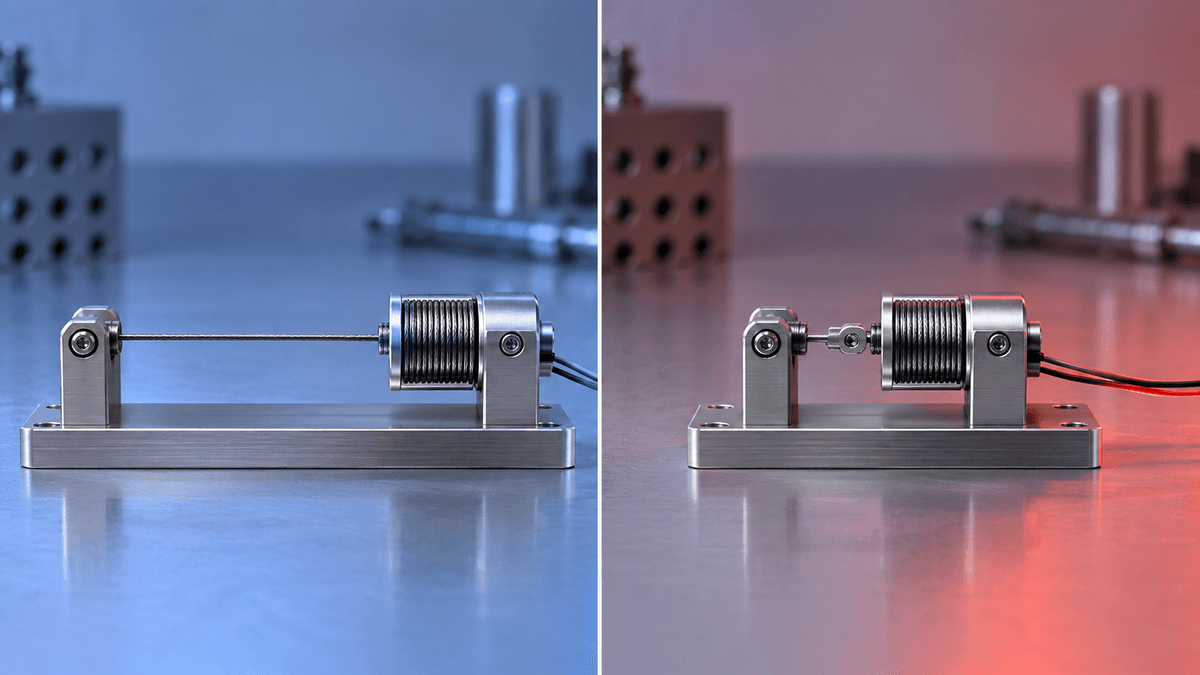
The wire does not transform at a single temperature. Heating and cooling follow different paths, so the actuator can remain in its hot shape after the heat source is removed until it cools sufficiently. This hysteresis is useful for passive switching and holding behavior, but it complicates precise proportional control.
GEE SMA product notes list multiple binary shape-memory grades and copper-containing grades across different Active Af bands. Choose the band around the real ambient range, heat source, allowable surface temperature, and required reset time. GEE SMA's temperature-triggered wire selection keeps the thermal margin connected to the application instead of treating Af as a catalog label.
Cooling Usually Limits Cycle Rate
Electrical resistance heating can raise wire temperature quickly, but passive cooling through still air may be much slower. Wire diameter, active length, nearby insulation, mounting mass, airflow, liquid contact, and ambient temperature all influence the cycle. Increasing current shortens heating only up to the limits imposed by temperature overshoot, connection heating, and material durability.
Test the complete package, not an exposed bench wire. Use measured position or temperature to end the heating pulse, and do not begin another cycle until the reset criterion is met. Research on actively cooled SMA springs shows that changing the cooling path can materially change response, which is why cycle frequency cannot be specified from wire chemistry alone.
Ends and Electrical Contacts Need Their Own Budget
Soldering directly to nitinol is not a routine copper-wire operation. Crimps, mechanical clamps, welded transitions, or purpose-designed terminals are commonly evaluated. The joint must carry force and current without creating a sharp bend, local hot spot, slip, or surface damage.
Move the maximum working strain away from the termination and provide gradual load transfer. Measure voltage drop and temperature at both ends during repeated cycling. GEE SMA's formed-wire capability can support geometries that reduce assembly variability near the active length.
Design the Verification Around a Full Cycle
- Measure hot and cold positions, useful force, bias force, and stop loads.
- Record current, voltage, heating time, cooling time, and ambient conditions.
- Track residual displacement and resistance over representative cycles.
- Inspect crimps, clamps, guides, pulley contacts, and high-strain regions.
- Test minimum and maximum ambient temperature and obstructed-motion faults.
- Freeze wire grade, diameter, condition, surface, active length, and shape-setting history.
A successful nitinol memory wire design is a reversible mechanism, not a one-direction material demonstration. When the reset force, thermal dead band, cooling path, electrical drive, and end attachments are qualified together, the wire can deliver controlled motion rather than an impressive first cycle.