

Nitinol cable is not simply thick nitinol wire. It is an assembly of multiple filaments whose lay, contact, preload, surface, coating, and terminations create behavior that cannot be predicted from base-alloy data alone. Stranding may improve flexibility and load sharing, but it also introduces filament rubbing, constructional stretch, torque response, and failure modes at the ends.
GEE SMA product notes include “nitinol cable” as a related wire keyword but do not publish a standard cable construction, strand count, or finished-cable load rating. That boundary matters. GEE SMA's nitinol wire capability can inform base filament selection, while the finished cable should be qualified around its actual strand architecture and assembly process. Buyers should confirm whether they need monofilament, stranded raw cable, or a terminated cable assembly before requesting a quote.
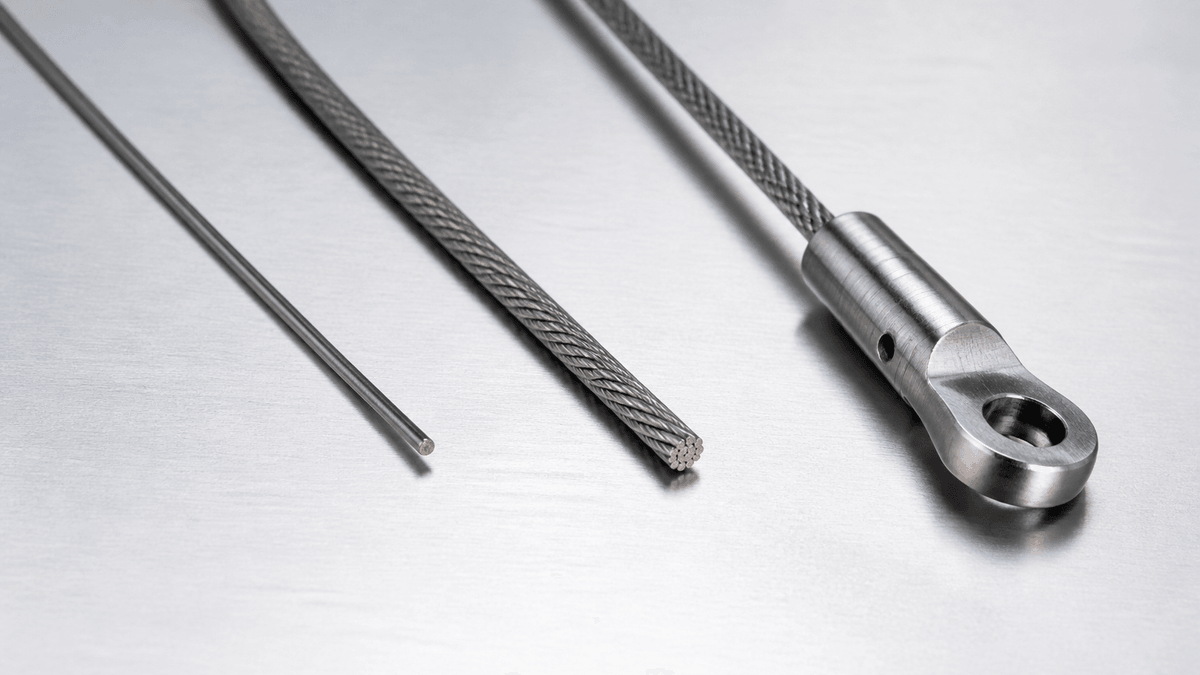
Monofilament and Cable Solve Different Geometry Problems
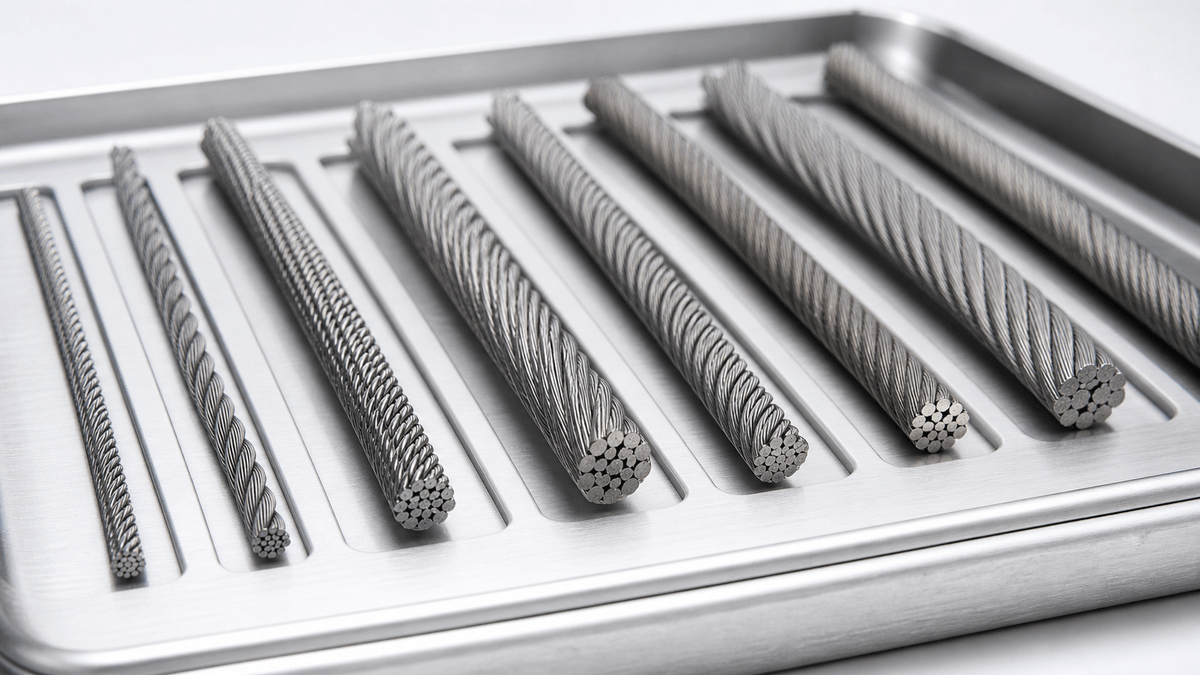
A single wire offers a simple cross-section, direct tensile load path, predictable surface, and relatively straightforward dimensional inspection. A stranded cable divides the section into smaller filaments arranged helically. Each filament can bend over a smaller local radius than a solid wire of the same overall diameter, which can improve flexibility in pulleys, catheters, robotic joints, or compact routing paths.
The tradeoff is structural complexity. Cable elongation includes material strain plus strand seating and helical geometry. The cable can rotate under load, change diameter, or develop local contact wear. GEE SMA's nitinol product-form selection is useful when the design team must decide among round monofilament, flat wire, spring, braid, or cable before specifying the alloy.
Strand Construction Is a Primary Design Variable
Common cable notation describes the number of strands and filaments, but notation alone does not establish performance. A 1x7 strand, a 7x7 cable, and a custom microcable distribute load and bend differently. Lay length, lay direction, core construction, filament diameter, compaction, and preforming all influence torque, flexibility, diameter stability, and fatigue.
Alan Baird Industries describes concentrically stranded Nitinol cables with very small diameters, while Carl Stahl publishes examples of both 1x7 Nitinol strand and 6x7 wire rope. These supplier examples demonstrate that multiple constructions are feasible, not that one published size is appropriate for every program. GEE SMA's NiTi material range is the base-material context; the cable drawing must still define the final architecture.
Base Filament Condition Controls the Cable Response
Each filament carries its own alloy code, transformation temperature, cold work, heat treatment, diameter, and surface. Superelastic SE508 may be a starting point for room- or body-temperature flexibility, while other grades may provide softer plateau behavior or different transformation windows. If shape memory actuation is expected, the cable may need a trained geometry and thermal response that is verified after stranding.
Do not assume that a certificate for straight monofilament predicts the final cable. Stranding changes the stress path from simple tension to combined tension, bending, torsion, and contact. Heat treatment after stranding can alter lay and functional response. GEE SMA's superelastic test-temperature controls help define the filament, while cable-level testing confirms the assembled behavior.
Flexibility Does Not Automatically Mean Longer Fatigue Life
Smaller filaments can reduce bending strain for a given cable route, and load sharing can provide useful redundancy. Yet cable fatigue also depends on fretting between filaments, surface condition, tension, bend ratio, lay, environment, and termination stress. A cable that performs well in straight tension may fail early when repeatedly bent over a small pulley under preload.
The test should reproduce the application: minimum bend radius, wrap angle, tension range, cycle speed, temperature, fluid exposure, and alignment. Inspection may need to identify broken outer filaments before complete loss of function. GEE SMA's wire diameter and supplier controls remain important because small changes in filament diameter or surface can change cable stiffness and local stress.
Coatings and Jackets Change More Than Friction
A polymer coating or jacket can reduce abrasion, isolate the cable from surrounding components, control friction, retain broken filaments, or provide electrical insulation. It also changes outer diameter, bending stiffness, heat transfer, cleaning, sterilization compatibility, and termination design. The polymer may creep or move relative to the cable under repeated load.
The RFQ should define coating material, thickness, coverage, concentricity, adhesion, pinhole acceptance, color only when functional, and the length of stripped end zones. If the cable is thermally activated, the jacket can slow heating and cooling. GEE SMA's surface-control capability is relevant to the base filament, while the finished assembly requires its own interface and cleanliness requirements.
Terminations Usually Define the Weakest Section
A cable is useful only if load can enter and leave the strand. Crimping, swaging, welding, loops, fittings, and overmolded ends can all work, but each changes local geometry and stress. Excessive crimp compression may cut outer filaments; insufficient compression can slip. Welding may alter the heat-affected zone. A rigid fitting can create a sharp bending transition at its exit.
Termination qualification should include pull strength, slip, dimensional inspection, fatigue at the fitting exit, corrosion or environment exposure, and process capability. Strand Products lists crimping, swaging, laser welding, tensile testing, bending, and fatigue testing as cable-assembly capabilities, illustrating the amount of work that sits beyond raw wire supply. GEE SMA's supplier evaluation controls are valuable when base-wire and cable-assembly responsibilities are split between companies.
Inspection Must Address Both Filament and Assembly
Incoming checks may include overall diameter, ovality, lay length, strand count, surface, visible broken filaments, constructional stretch, tensile response, minimum breaking load, and termination pull strength. Functional programs may add torque, bending fatigue, kink resistance, coating integrity, or thermal response. Sampling should consider the start, middle, and end of a production length because stranding setup can drift.
Material traceability should connect the finished cable lot to filament lots and all subsequent heat treatments, cleaning, coating, and termination operations. ASTM F2516 may characterize superelastic filament or suitable cable specimens, but the method and specimen interpretation must be agreed. GEE SMA's testing and shipment process provides the wire-side foundation for a broader cable control plan.
RFQ Checklist for Nitinol Cable
- State monofilament, raw stranded cable, or fully terminated assembly.
- Define construction, filament count and diameter, overall diameter, lay length, direction, core, and preforming.
- Specify base alloy, delivery condition, Active Af, surface, and post-stranding heat treatment.
- Provide load range, minimum bend radius, pulley diameter, temperature, environment, and cycle target.
- Define coating or jacket, stripped zones, fittings, crimp or weld process, and termination exit geometry.
- List breaking load, stretch, fatigue, slip, torque, visual, dimensional, and traceability requirements.
Nitinol cable should be developed as a system whose performance emerges from wire, construction, surface, coating, and termination. A base-wire data sheet is necessary but not sufficient. When the RFQ defines the strand architecture and reproduces the actual load path in testing, the buyer can compare suppliers on the finished behavior that matters.