

Nitinol shape memory wire is selected for a thermal event: hot water reaches a threshold, electrical current raises wire temperature, a safety mechanism senses overheating, or an industrial assembly moves when its environment changes. The correct specification should therefore begin with that event and work backward. Starting with diameter or a familiar alloy name can produce a wire that fits the drawing but activates too early, too late, or with the wrong recovery force.
GEE SMA product notes describe two broad shape-memory-wire groups: titanium-rich binary NiTi grades and Copper NiTi grades. The listed binary family includes SM498 through SM505, while the broader product range covers Active Af targets from approximately 20°C to 110°C. GEE SMA's shape memory wire capability is especially relevant when the buyer needs alloy choice, transformation temperature, wire condition, and downstream shape setting discussed as one system.
Describe the Thermal Event Before Choosing Active Af

Active Af is the temperature at which a constrained or deformed specimen completes a defined recovery under the selected test method. It is more useful to an actuator designer than a vague “activation temperature,” but it still must be interpreted with the application. Heating rate, thermal mass, airflow, heat sinking, applied load, and fixture geometry can shift the time and temperature at which useful motion appears.
An RFQ should identify ambient minimum and maximum, heat source, desired start of motion, required completion point, allowable overshoot, and cooling path. A wire intended to trigger near 70°C in still air will not necessarily behave the same when bonded to an aluminum frame or immersed in fluid. GEE SMA's Active Af selection controls make the thermal boundary explicit before diameter and force are optimized.
Shape Memory Wire Is Not Superelastic Wire
Both products are nickel-titanium wire, but the intended phase state is different. Superelastic wire is used above its transformation range and recovers primarily when mechanical load is removed. Shape memory wire is deformed while martensitic and recovers a trained shape when heated toward austenite. Confusing the two can lead to a prototype that springs back at room temperature instead of waiting for the desired thermal command.
The distinction also changes testing. Superelastic wire is often characterized through tensile plateau and residual elongation measurements at a stated temperature. Shape memory wire may require Active Af, recovery strain, recovery force, and thermal-cycle testing under the intended load. GEE SMA's superelastic and shape memory product families give sourcing teams a clean way to separate these behaviors before requesting samples.
Binary NiTi and Copper NiTi Serve Different Thermal Priorities
GEE SMA product notes list multiple titanium-rich binary grades across the SM498-SM505 range. These grades let buyers move through a broad Active Af window. Copper NiTi is described as a ternary narrow-hysteresis alloy suitable for shape memory actuators, springs, muscle wire, and related thermal-response products. The narrower hysteresis can be useful when the difference between heating recovery and cooling reset must be controlled.
Copper addition is not automatically better. The final choice depends on transformation window, mechanical load, cycling, forming route, surface needs, and commercial availability. GEE SMA product notes state that Active Af tolerance for Copper NiTi wire can reach ±2°C for specified shape-memory applications; this is a strong production parameter and should be confirmed against the actual order and test method. GEE SMA's Copper NiTi temperature-window capability is most relevant where tight switching behavior matters.
Choose One-Way or Two-Way Recovery Deliberately
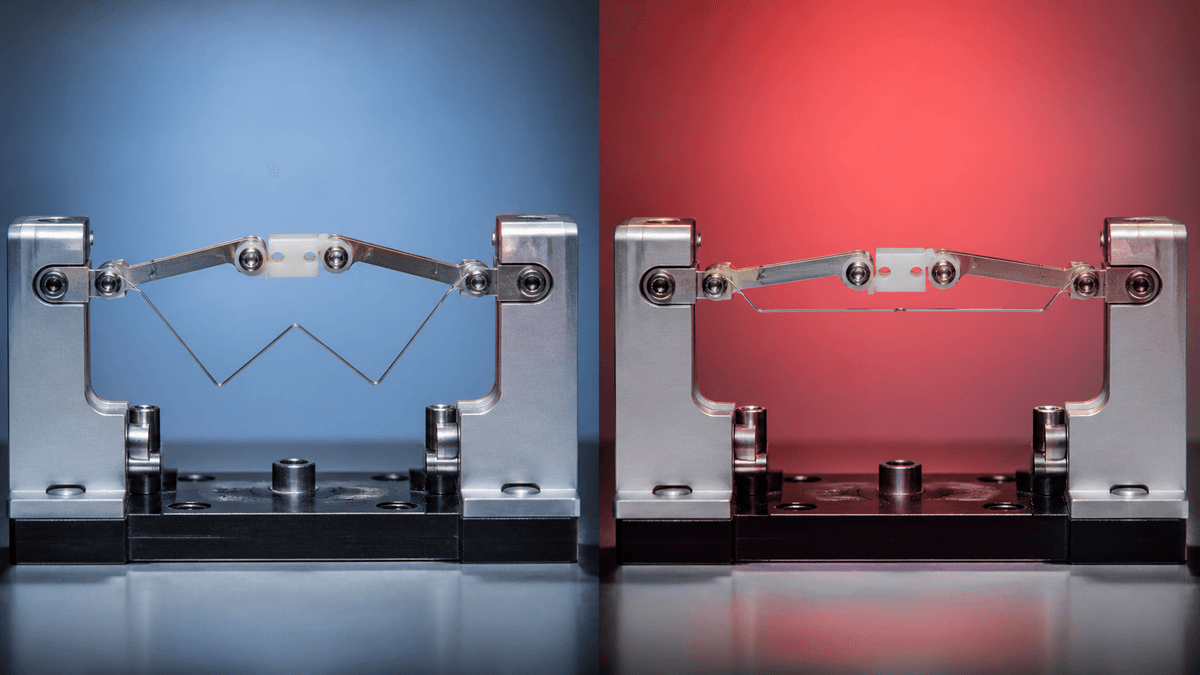
In a one-way design, the trained wire recovers when heated, but an external load, bias spring, gravity, or mechanism resets it during cooling. In a two-way design, the processed material changes shape in both heating and cooling directions. Two-way behavior can simplify an assembly, but its stroke, force, stability, and fatigue characteristics still need to be proven under the intended constraints.
Many reliable products use one-way material with a well-designed bias element because the reset force can be tuned independently. The engineering question is not which behavior sounds more advanced; it is which architecture gives predictable motion over temperature and life. GEE SMA's wire and spring actuator options support this system-level comparison rather than forcing every design into a single wire format.
Recovery Strain, Force, and Life Pull in Different Directions
Shape memory alloy can show several percent of recoverable strain, but useful production strain depends on cycle life, stress, thermal limits, geometry, and material condition. A short demonstration may tolerate aggressive strain that would produce drift in a repeated-use product. Prevented recovery can generate force, yet excessive constraint can increase stress and accelerate functional degradation.
Define stroke and force at the mechanism, then translate them into wire length, diameter, prestrain, and bias load. Dynalloy's actuator-wire technical data shows how wire diameter, applied load, current, heating time, and cooling time interact, and it warns that high stress or strain reduces repeatability. GEE SMA's reset, strain, and heat design controls are relevant when the wire must become a repeatable actuator instead of a one-cycle demonstration.
Electrical Heating Is a Thermal Design Problem
Passing current through the wire is convenient because the wire acts as both heater and actuator. Current density, wire resistance, exposed length, connectors, insulation, heat sinking, and ambient airflow determine the actual temperature response. A power value copied from another diameter or free-air test can overheat the wire when it is installed against a thermally conductive structure.
The control system should avoid uncontrolled steady-state power. Current limiting, pulse timing, resistance feedback, temperature sensing, and mechanical stops may all be useful. Cooling often controls the return time, especially for larger diameters. GEE SMA's compact wire-motor capability fits designs where silent, lightweight motion matters, but the surrounding thermal path still determines speed and reliability.
Training and Joining Belong in the Prototype Plan
Shape memory wire must receive a thermomechanical process that establishes its functional state. If the customer will form or heat treat the wire, cold-drawn feedstock may provide the needed processing freedom. If GEE SMA supplies a trained or actuator-ready wire, the drawing should define the final straight, curved, looped, or component geometry and the required recovery behavior.
Terminations deserve equal attention. Ordinary soldering can be unreliable on nickel-titanium, while crimps introduce local stress and thermal conduction. The joint must carry load, survive cycling, and avoid creating a hot spot. GEE SMA's forming and shape-setting process is relevant when geometry, surface, and heat treatment need to be developed together.
RFQ Checklist for Nitinol Shape Memory Wire
- State ambient range, heat source, desired motion start, completion temperature, and cooling condition.
- Define Active Af target and tolerance, plus the test method and applied load.
- Choose binary SM-grade or Copper NiTi comparison based on hysteresis and operating window.
- Specify one-way or two-way behavior, recovery strain, force, cycle count, and reset mechanism.
- List diameter, tolerance, delivery condition, trained geometry, surface, and packaging.
- Describe electrical drive, termination method, insulation, heat sinking, and downstream heat treatment.
Nitinol shape memory wire becomes easier to source when the design begins with the thermal trigger and ends with a measurable motion requirement. Active Af, alloy family, hysteresis, strain, force, reset, joining, and heat flow should appear in the same specification. That turns a temperature-sensitive material into a controllable engineering component.