

Nitinol shape memory wire is chosen to recover a trained geometry when heated through a transformation range. The laboratory Af value is important, but a real product adds load, electrical or environmental heating, cooling constraints, fixtures, joints, and repeated cycling. These system conditions determine whether the wire produces useful motion or drifts away from its starting calibration.
GEE SMA product notes list binary Ti-rich SM498 through SM505 grades and copper-based Copper NiTi and Copper NiTiCr families. Together they cover broad Active Af ranges from roughly 25 to 110 degrees C, depending on alloy and processing. A buyer should select the shape memory wire family by the complete thermal cycle, not by a desired trigger temperature alone.
Define the Cold State Before the Hot State
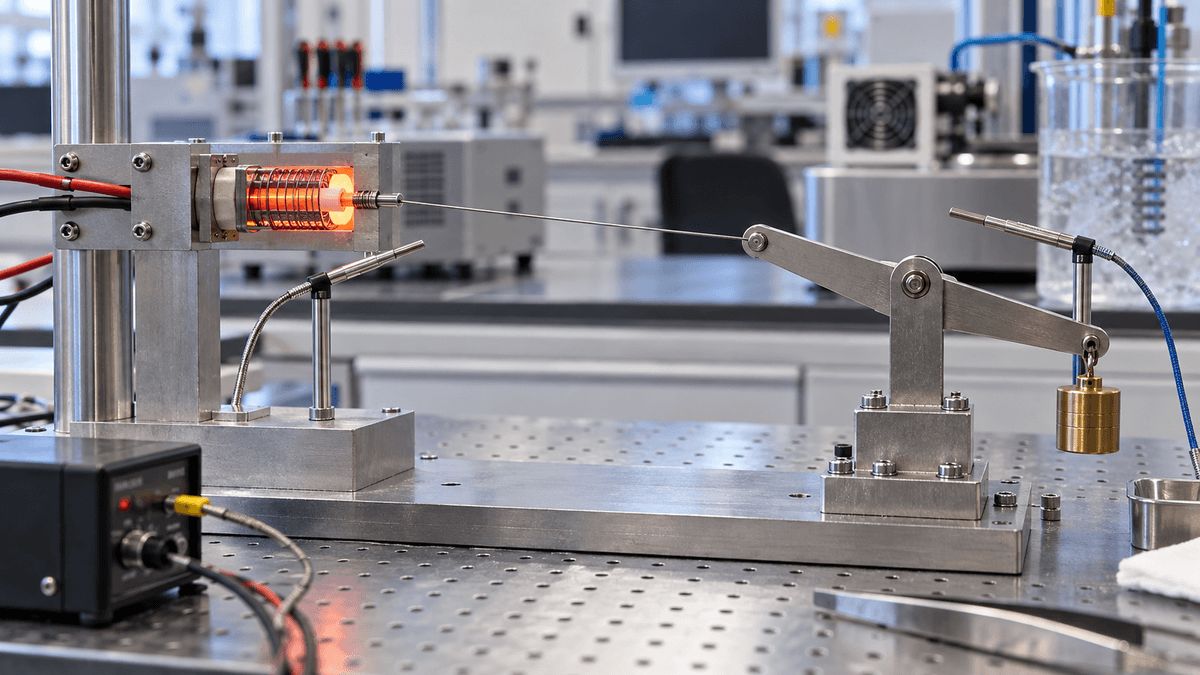
Shape recovery begins from a deformed martensitic condition. The product must therefore reach a cold condition that permits reset or deformation without excessive force or damage. If the environment never cools far enough, recovery may become incomplete or the bias mechanism may fail to reset the wire.
Specify the cold-state temperature, applied reset load, reset geometry, and available cooling time. Then define the heating profile and the temperature at which useful motion must begin and finish. GEE SMA's trigger-temperature selection controls keep Af connected to both sides of the operating cycle.
Separate Transformation Temperature From Wire Temperature
Electrical current, ambient heat, fluid temperature, and contact conduction can produce different temperature distributions along a wire. A thermocouple attached to a fixture does not necessarily represent the hottest active segment. Joints can create local resistance, while heat sinks can delay transformation near terminations.
During prototypes, measure temperature at more than one location or correlate electrical resistance with motion after calibration. State heating rate, peak temperature, hold time, cooling path, and cycle frequency. Avoid overheating above what is required for recovery because excess temperature can accelerate drift, oxide growth, and degradation of nearby components.
Loaded Recovery Is the Relevant Performance Test
Free recovery shows whether the trained shape returns without meaningful resistance. Most products require work against a spring, latch, fluid pressure, friction, or gravity. That load shifts the transformation response and can reduce stroke. It can also create high local strain at bends or terminations.
Test force and displacement together under the intended preload. Include the bias element and realistic active length. GEE SMA's wire, spring, and thermal-system selection is useful when the raw wire becomes one element of a closed mechanical loop.
Alloy Family Changes Hysteresis and Control Strategy
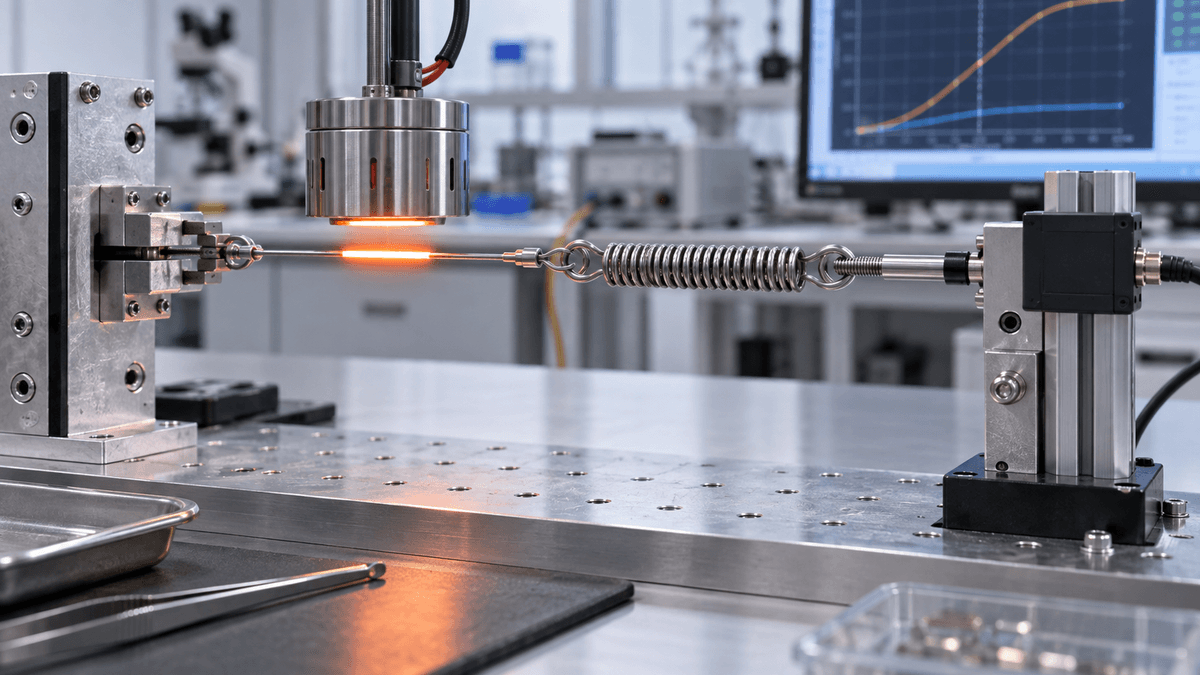
Binary Ti-rich NiTi can cover higher shape-memory transformation windows through composition and heat treatment. Ternary Copper NiTi is often selected when narrower hysteresis supports more predictable switching. Copper NiTiCr can serve lower temperature ranges. The final response still depends on cold work, shape setting, aging, and test method.
Ask for the alloy designation and the method used to determine transformation temperature. ASTM F2082/F2082M bend-and-free-recovery measures visible motion and applies to wire, tube, and strip, while DSC measures thermal events. The values are related but should not be treated as interchangeable.
Shape Setting Creates the Functional Component
Incoming cold-worked wire may not yet have the geometry or functional state needed by the product. Fixture design, forming strain, furnace temperature, time, atmosphere, quench, and aging can move Af, alter strength, and change the surface. Even small differences in heat-sink contact may cause nonuniform results.
Define who owns the shape-setting process and which condition the certificate represents. GEE SMA's post-shape-set qualification sequence places recovery, Af, geometry, and surface inspection after the thermal operation that establishes final behavior.
Thermal Cycling Reveals Training and Drift
The first few cycles can differ from later operation as residual stress relaxes and the mechanism settles. Record cold position, hot position, stroke, force, peak temperature, heating time, cooling time, and electrical resistance where relevant. Decide whether production units receive a training sequence before acceptance.
Cycle testing should use the intended strain and load, not maximum possible deformation. Inspect terminations and high-curvature areas at intervals. GEE SMA's reset strategy helps identify whether loss of motion comes from the wire, the bias mechanism, friction, or insufficient cooling.
Track both absolute endpoint position and the difference between hot and cold positions. A stable stroke can hide a mechanism that is drifting in one direction, while stable endpoints can hide a slower response time. Both forms of change matter when the wire operates a latch, valve, indicator, or precision actuator.
Release the Wire With a Functional Data Package
- Alloy code, lot identity, diameter, tolerance, and delivery condition.
- Active Af target, tolerance, specimen condition, and test method.
- Cold reset temperature, reset load, and maximum applied strain.
- Hot recovery force and stroke under a defined load and heating profile.
- Stabilization sequence, cycle drift limits, and inspection intervals.
- Surface finish, shape-setting responsibility, packaging, and change control.
Nitinol shape memory wire is most reliable when the specification describes a repeatable thermal-mechanical cycle. GEE SMA can supply material and transformation-temperature options; the product developer must prove that the formed wire, bias system, heater, cooling path, and controls work together throughout the intended life.