

Metal nitinol is often discussed as if its properties belonged to a fixed grade. In practice, the same nominal nickel-titanium composition can feel softer, stiffer, more recoverable, or more forceful as temperature and processing change its phase state. A test at 20 °C may not predict behavior at 37 °C, and a transformation result from fully annealed material may not describe cold-worked, straight-annealed, or shape-set product.
Start With the Distance Between Use Temperature and Af
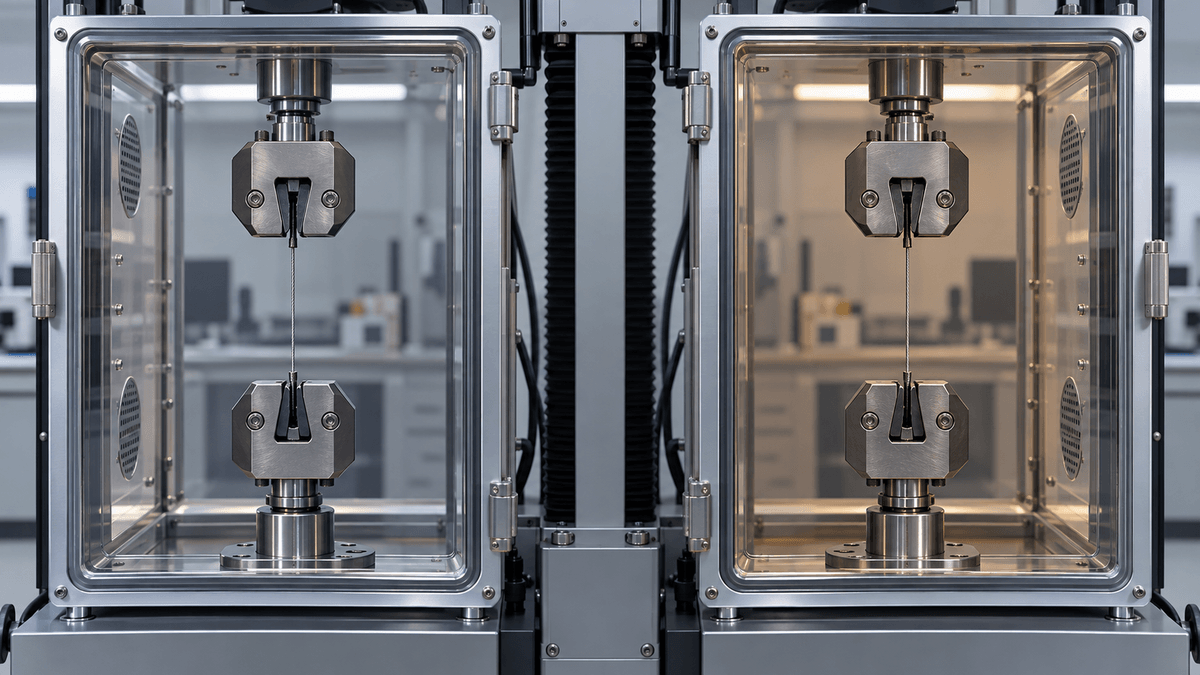
Superelastic behavior generally appears when the use temperature is sufficiently above the austenite finish temperature, Af. Stress can then induce martensite during loading, followed by reverse transformation during unloading. When the temperature sits closer to the transformation range, plateau stress and recovery can shift. Below the relevant range, the material may be more martensitic and respond differently.
Therefore, an Af number has meaning only with a test method and material condition. GEE SMA's technical data on DSC, bend-and-free-recovery, and active Af distinguishes baseline transformation behavior from response in a processed product.
Why Room-Temperature Inspection Can Mislead
A guidewire or frame inspected on a 20 °C bench may operate around body temperature. An actuator may run far hotter than its ambient surroundings. A cold-environment component may sit below the state used in factory testing. These differences alter force, hysteresis, recovery, and permanent set. Passing a simple bend check at room temperature does not establish performance across the service window.
The test matrix should include the low, nominal, and high temperatures that matter to the application. GEE SMA's test-temperature controls for superelastic wire help make supplier and buyer data comparable.
Cold Work Stores a Processing History
Drawing, rolling, and other deformation change strength and the later response to heat treatment. GEE SMA product notes describe as-drawn wire as cold worked, with cast and twist, while straight-annealed wire has received straightening heat treatment and may exhibit superelastic behavior when tested sufficiently above its applicable Af. Those conditions may share chemistry but are not substitutes.
Cold work can raise mechanical characteristics after an equivalent heat treatment and can also shift transformation temperatures. A buyer should state whether material will be formed and shape set later or must arrive ready for functional testing. GEE SMA's forming and shape-setting controls connect the supplied state to the intended final geometry.
Heat Treatment Trades Force, Temperature, and Recovery

Shape-setting time, temperature, fixture constraint, section size, prior cold work, and cooling route can all influence final behavior. Changing heat-treatment time and temperature can shift transformation temperatures, plateau stress, hysteresis, and resistance to permanent set. The direction and magnitude must be established for the specific alloy, prior cold-work state, diameter, and geometry; there is no universal recipe.
Development should use representative cross-sections and fixtures, then verify the output after the complete thermal cycle. GEE SMA's actuator-wire capability is relevant when a program must coordinate active temperature, load, stroke, and electrical heating.
Product Form Changes the Thermal and Mechanical Response
Wire, flat wire, sheet, tube, rod, and spring do not cool, heat, or carry strain in the same way. A thin wire responds quickly but may be sensitive to termination and surface defects. A spring converts wire strain into a larger structural stroke. Sheet and tube introduce texture, thickness, and geometry effects. The correct test must represent the product form rather than only the alloy family.
GEE SMA's nitinol material portfolio allows the form decision to follow the intended motion, load path, and manufacturing route.
Specify a Behavior Window Instead of a Metal Name
A useful specification states the operating temperature range, target transformation metric, test method, material condition, dimensions, surface, mechanical response, and allowable permanent set. For cyclic applications, add preconditioning and cycle count. For actuators, include heating method, load, stroke, duty cycle, cooling path, and reset strategy.
| Specification item | What to define |
|---|---|
| Functional mode | Superelastic response, one-way shape recovery, or thermally driven actuation |
| Temperature window | Minimum, nominal, and maximum service and test temperatures |
| Transformation metric | Af definition, method such as DSC or bend-and-free-recovery, specimen condition, and acceptance range |
| Mechanical response | Force or plateau-stress window, strain, hysteresis, recovery, and allowable permanent set |
| Test history | Preconditioning method, cycle count, strain rate, and temperature stabilization |
ASTM F2063 also reinforces an important principle: chemistry alone cannot guarantee shape-memory or superelastic properties. Current material requirements use thermomechanical characterization because small changes in composition and processing have large effects on transformation temperature.
Use the Service Condition as the Acceptance Condition
Consider a superelastic wire intended to flex at 37 °C. A smooth loading and unloading curve measured at 22 °C may be useful for process monitoring, but it does not by itself establish plateau force, residual strain, or cyclic stability at the use temperature. The acceptance plan should test representative material at 37 °C, or justify a validated correlation between the production test temperature and the service condition.
The same discipline applies to an actuator. A free-recovery Af value does not replace a force-and-stroke test under the intended bias load, heating method, and cooling path. Intrinsic alloy behavior provides a starting point; final performance belongs to the processed product in its working condition.
Test the Condition That Will Actually Work
The phrase metal nitinol identifies a nickel-titanium alloy family, but engineering performance belongs to a specific state. The most useful supplier conversation is not "Do you sell nitinol?" It is "Can this form, condition, surface, and transformation window produce the required response at our service temperature?" GEE SMA's form-and-alloy sourcing map helps turn that question into a practical starting specification.