

Nitinol strip gives designers a broad, thin cross-section for springs, clips, thermal switches, flexures, shields, and cut components. It should not be specified as round wire with a width added. Rolling direction, thickness variation, edge condition, coil set, flatness, surface, and thermal history all influence how the material forms and transforms.
GEE SMA product notes define strip as flat-rolled NiTi under 0.5 mm [0.020 in.] thick and under 50 mm [1.969 in.] wide. Available routes include cold-rolled material for later shape setting and superelastic material prepared for downstream processing. This range of NiTi product forms lets buyers start with the condition their own manufacturing route actually needs.
Thickness Is a Functional Dimension

In bending, small changes in thickness can produce meaningful changes in stiffness and stress. A thermal latch or flexure may therefore move differently across a coil even when width is stable. Thickness should be measured at an agreed distance from each edge and at defined intervals along the length, with sampling that can detect both local and long-range variation.
GEE SMA product notes list graduated thickness tolerances that widen as nominal strip thickness increases. Buyers should confirm the applicable range for the requested size rather than copying one tolerance across all gauges. For slit material, edge regions and center regions may also need separate checks.
Flatness Is Not the Same as Coil Set
Flatness describes local departure from a plane; coil set describes the material's tendency to curve after uncoiling. Camber, or lateral sweep along the strip, is another independent characteristic. A strip can satisfy a local flatness check and still be difficult to feed through a laser, stamping tool, or automated fixture because residual curvature remains.
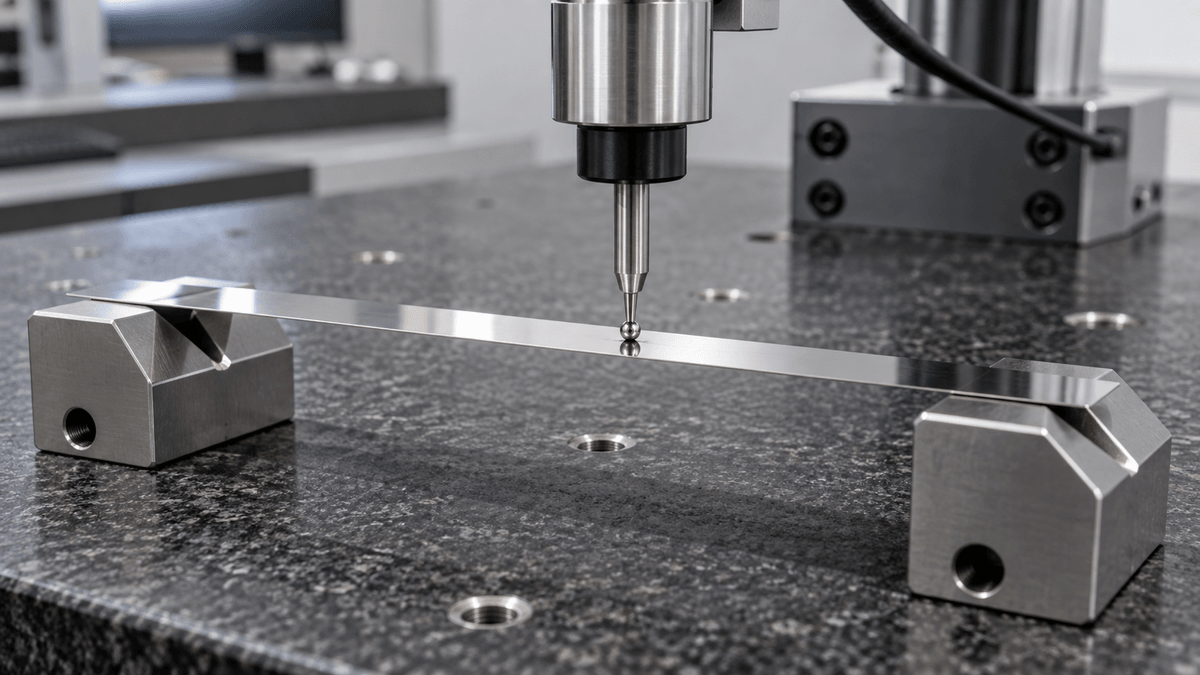
GEE SMA product notes state a local flatness control of 0.1 mm over 10 mm. A purchase drawing should define the measurement support, gauge method, sampling location, and whether coil set or camber has a separate limit. GEE SMA's process and inspection controls can then be matched to the feed and forming equipment.
Rolling Direction Follows the Part Into Service
Cold rolling creates directional texture, residual stress, and a substantial cold-worked state. Parts cut parallel and transverse to the rolling direction may not behave identically after forming and heat treatment. Nesting orientation can therefore affect spring response, fracture risk, and dimensional stability.
Mark the rolling direction on coil and sheet documentation, then preserve it through blanking trials. If the component contains narrow ligaments, slots, or severe bends, compare candidate orientations before releasing a high-volume nest. GEE SMA's rolled-versus-drawn manufacturing distinctions reinforce why a flat cross-section needs its own process history.
Choose Cold-Rolled or Functional Condition Deliberately
Cold-rolled strip retains process freedom for blanking, forming, and shape-setting at the customer. Its final Active Af, strength, and recovery depend on the customer's thermal cycle. Superelastic strip has already received a functional heat-treatment route, but later thermal exposure can change that delivered behavior.
The order should state whether transformation requirements apply to incoming strip, a heat-treated coupon, or the final component. GEE SMA product notes include superelastic and shape-memory alloy codes, with superelastic Active Af options near typical ambient conditions and shape-memory options extending to higher temperatures. Those ranges require confirmation for the exact size and final process.
Edges Often See the Highest Risk
Slitting, shearing, laser cutting, electrical discharge machining, stamping, and grinding can leave burrs, recast layers, notches, or heat-affected regions. Because many strip components concentrate stress at an edge, the cutting route can dominate fatigue or fracture even when the parent surface is smooth.
Specify burr direction, maximum burr, corner break, edge roughness, and any post-cut finishing. Inspect internal features as well as outside edges. GEE SMA's NiTi component capability is particularly relevant when the blanking, shape setting, and surface finishing must be validated as one sequence.
Surface Finish Must Survive Downstream Work
GEE SMA product notes describe smooth oxide and bright finish options, with surfaces expected to be smooth, clean, and uniform. The best starting finish depends on the downstream operation. A bright surface may aid inspection and reduce cleanup; an oxide-bearing surface may be acceptable when later processing removes or replaces it.
Do not specify appearance alone. Identify pits, scratches, embedded debris, roll marks, discoloration, and contamination that are unacceptable for the component. Where medical use is intended, material standards and device-specific regulatory expectations must be evaluated separately; a raw-material reference is not finished-device approval. GEE SMA's material-versus-device boundary keeps those responsibilities clear.
Incoming Inspection Should Predict Manufacturability
- Nominal thickness and width, tolerances, sampling frequency, and measurement method.
- Coil or cut-length supply, inside diameter, maximum coil set, camber, and local flatness.
- Rolling direction, alloy code, delivery condition, and retained cold work.
- Active Af target, test method, specimen condition, and heat-treatment ownership.
- Parent surface, edge finish, burr limit, cleanliness, and protective packaging.
- Downstream cutting, forming, shape setting, joining, cleaning, and functional tests.
A useful nitinol strip specification predicts whether the material will feed, cut, form, transform, and survive in the intended component. Thickness is only the first line; flatness, rolling history, edges, surface, and final heat treatment complete the functional definition.