

What Is Nitinol?
Nitinol — short for Nickel Titanium Naval Ordnance Laboratory — is a metallic alloy made of roughly equal parts nickel and titanium. It is also referred to as NiTi, nickel-titanium alloy, or simply shape memory alloy (SMA). Nitinol was first discovered in the early 1960s at the U.S. Naval Ordnance Laboratory, and since then it has become one of the most important functional materials in modern engineering.
What makes nitinol wire different from ordinary metal wire — such as stainless steel, spring steel, or titanium alloy — comes down to two extraordinary physical properties: the shape memory effect and superelasticity. Together, these properties allow nitinol to do things no conventional metal can: compress into a tiny delivery catheter and spring open inside a blood vessel, bend into a knot and snap back to its original shape, or “remember” a preset form and return to it on command when heated.
Because of this, nitinol has moved from a laboratory curiosity into a mainstream industrial material used in everything from heart stents to eyeglass frames and spacecraft components. This guide explains how nitinol works, where nitinol wire and sheet are used across industries, and what to look for when sourcing a nitinol manufacturer.
How Nitinol Works: Shape Memory Effect vs. Superelasticity

Shape Memory Effect
Nitinol can be deformed while cool and then “remember” its original, preset shape when heated above a specific transformation temperature. This happens through a reversible solid-state phase transformation between two crystal structures — martensite, the low-temperature and more malleable phase, and austenite, the high-temperature and more rigid phase — rather than through melting or ordinary mechanical spring-back.
This is the mechanism behind nitinol actuator wire, also called nitinol muscle wire: apply an electrical current or heat, and the wire contracts like a muscle fiber; remove the heat, and it relaxes. Robotics engineers use this property to build lightweight actuators that can replace bulkier electric motors.
Superelasticity (Pseudoelasticity)
At body or room temperature, superelastic nitinol wire can be stretched or compressed far beyond the elastic limit of ordinary metals — often up to approximately 8% strain — and spring back to its original shape once released, with no permanent deformation. This is why a strand of nitinol wire can be tied into a knot and still return to its original straight form, something impossible with stainless steel.
Combined with excellent biocompatibility, corrosion resistance, and fatigue resistance, these two properties explain why nitinol has become a preferred material across medical, industrial, aerospace, textile, and consumer applications.
Key Applications of Nitinol Shape Memory Alloy
1. Medical Devices — The Largest Nitinol Market
Nitinol’s biocompatibility and superelasticity make it a widely used material for minimally invasive medical technology:
- Cardiovascular stents: Compress for catheter delivery and self-expand once positioned in a vessel.
- Guidewires and catheters: Used throughout interventional cardiology and radiology.
- Orthopedic implants: Include spinal correction rods, bone anchors, and compression staples.
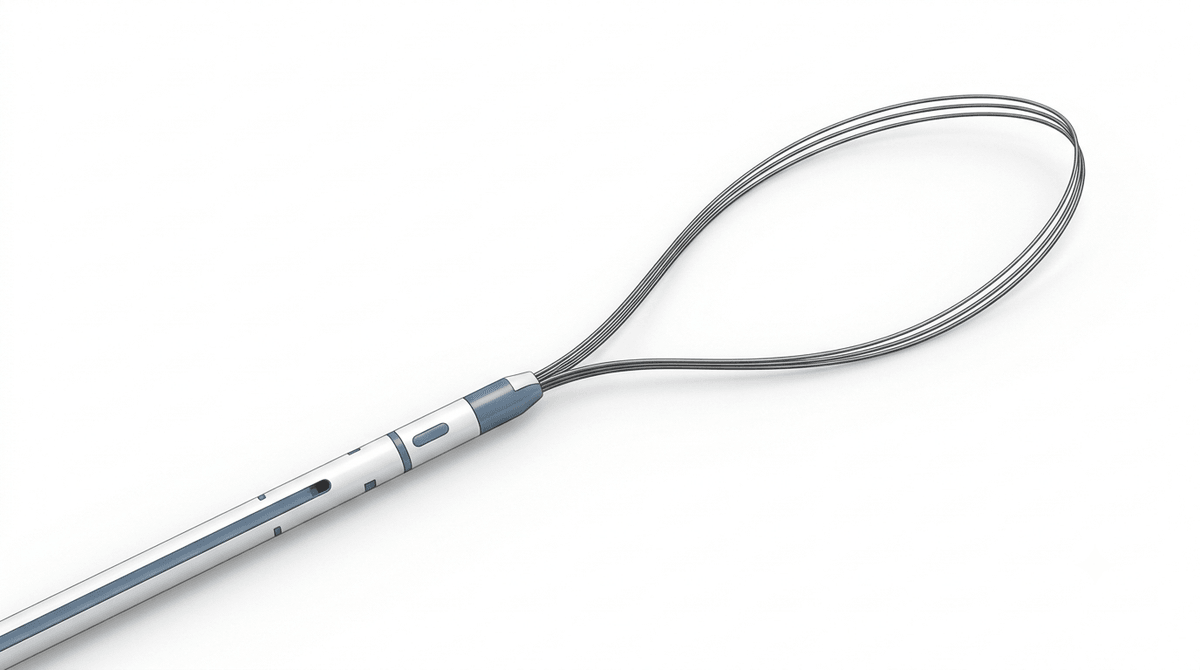
- Surgical instruments: Include stone-retrieval baskets, IVC filters, and localization wires.
2. Dental and Orthodontic Wire
NiTi orthodontic archwires deliver continuous, gentle corrective force over time. Unlike stainless steel archwires, which lose tension and require frequent manual adjustment, nitinol helps maintain a more consistent force profile. This can reduce patient chair time and improve treatment consistency, which is why nickel-titanium wire has become standard in modern orthodontic practice.
3. Textiles and Apparel — Bra Underwire and Support Structures
One of the lesser-known applications of shape memory alloy wire is in intimate apparel, particularly bra underwire. Compared with conventional spring steel, nitinol wire can offer:
- Consistent shape recovery after washing, compression, and daily wear.
- Improved wearer comfort through a low, gradual force curve.
- Long-term resistance to deformation and wire poke-through, a common failure mode with stainless steel.
These properties make nitinol wire an attractive option for premium innerwear manufacturers seeking a durable and comfortable alternative to traditional underwire materials.
4. Aerospace and Deployable Structures
- Deployable structures: Satellite antennas and solar-panel hinges that unfold through heat-activated shape recovery, reducing the need for motors.
- Adaptive components: Actuation systems that respond automatically to temperature changes.
- Compact nitinol actuators: Replace electric motors in space- and weight-constrained spacecraft systems.
- Extreme-environment mechanisms: Nitinol-based components can provide reliable actuation in demanding aerospace conditions.
5. Robotics and Automation
Nitinol muscle wire is widely used as an artificial-muscle actuator in robotics, prosthetics, and automated control systems. It offers silent, lightweight, low-voltage actuation that can be difficult to replicate with conventional motors or hydraulics.
6. Industrial and Consumer Products
- Eyewear frames: Flex and twist without bending permanently.
- Pipe couplings and fittings: Use shape recovery to form a seal without welding.
- Antenna wire and fishing line: Benefit from superelastic recovery.
- Seismic damping components: Used in construction and automotive engineering.
- Toys and education kits: Demonstrate visible shape-memory behavior for teaching and experimentation.
Nitinol vs. Stainless Steel vs. Spring Steel
| Property | Nitinol (NiTi) | Stainless Steel | Spring Steel |
|---|---|---|---|
| Elastic strain recovery | Up to ~8% | ~0.2–0.3% | ~0.3–0.5% |
| Biocompatibility | Excellent | Moderate | Poor |
| Corrosion resistance | Excellent | Good | Moderate |
| Fatigue life | Very high | Moderate | Moderate |
| Shape memory function | Yes | No | No |
| Typical use case | Medical, apparel, aerospace | General industrial | General industrial |
For applications requiring repeated flexing, biocompatibility, or self-expanding and self-recovering behavior, nitinol can outperform conventional metals. Although it usually carries a price premium, it can provide longer service life and improved end-user performance in suitable applications.
Nitinol Alloy Grades and Composition
Not all nitinol is the same. Suppliers typically offer multiple alloy families engineered for different transformation temperatures and mechanical behaviors:
- Binary NiTi alloys, such as SE 508 and LSE 507 ELI: Standard superelastic or shape-memory grades for medical and industrial use, defined by their atomic-percent nickel-titanium ratio.
- NiTiNb (niobium): A wide-hysteresis alloy suited to mechanical and aerospace engineering, with adjustable low-temperature superelasticity.
- NiTiFe (iron): Lowers transformation temperature and can improve cold-workability for low-temperature applications.
- NiTiHf (hafnium): A high-temperature shape memory alloy for actuation systems operating above 120°C.
- Copper-doped NiTi: Narrows phase-transition hysteresis for fast-responding, sensitive components.
- ELI (extra-low-interstitial) grades: Used for body-temperature medical applications where purity and consistency are especially important.
Precise atomic-percent Ni-Ti composition control during vacuum melting determines transformation temperatures such as Af, As, Ms, and Mf. This is why composition and transformation-temperature test reports are essential when sourcing nitinol wire for a regulated or performance-critical application.
Choosing a Nitinol Manufacturer: What to Look For
Sourcing nitinol wire, rod, or sheet requires more diligence than sourcing conventional metal because final performance is highly sensitive to melting and processing quality:
- Composition control (Ni:Ti ratio, weight percent, and atomic percent): Even small variances can shift transformation temperature and mechanical behavior.
- Transformation-temperature testing (Af, As, Ms, Mf): Confirms that the alloy performs correctly at the intended use temperature.
- Melting method: Vacuum processing supports composition uniformity and controlled material performance.
- Surface finish and oxide-layer control: Can affect fatigue life and, in medical or skin-contact applications, comfort and safety.
- Standards compliance: ASTM F2063 is an important material reference for wrought nickel-titanium alloys used in medical and surgical applications.
- Batch consistency and traceability: Essential for regulated industries and long-term supply relationships.
- Composition and test reports: A reputable supplier should provide appropriate documentation for each production batch.
About GEE SMA — A Nitinol Manufacturer in China
GEE SMA’s research into nickel-titanium shape memory alloys traces back to 1980, and Beijing GEE SMA Technology Co., Ltd. was formally established in 1998. Over more than two decades, the company has built an integrated production chain that includes melting, forging, rolling, drawing, grinding, polishing, and heat treatment.
In 2019, the company established Zhuozhou GEE SMA Technology Co., Ltd. as a dedicated production and R&D base. In 2023, it launched Xian GEE SMA Import and Export Co., Ltd. as a specialized foreign-trade entity, enabling international customers to source nitinol materials and components directly from the manufacturer.
Today, GEE SMA offers multiple nickel-titanium alloy families, including NiTi, NiTiNb, NiTiFe, NiTiHf, and copper-doped NiTi. Available product forms include ingot, bar, wire, plate, sheet, coil, ribbon, and foil. The company also supports fine wire, thin plate, custom alloy development, transformation-temperature testing, and batch documentation.
GEE SMA materials have been used in medical devices, aerospace, communications equipment, scientific research, and automatic control systems. Customers can review the company’s product range, learn more about its manufacturing mission and capabilities, or explore its technical information.
Looking for a reliable nitinol wire supplier?
Discuss your required alloy composition, transformation temperature, dimensions, surface condition, and batch-testing needs — from R&D sample quantities to production volumes.
Frequently Asked Questions
Is nitinol the same as nickel titanium?
Yes. “Nitinol” is the common name for nickel-titanium shape memory alloy, or NiTi. The terms generally refer to the same material family.
What is the difference between shape memory and superelastic nitinol?
Shape-memory nitinol needs heat to trigger recovery to its preset shape, making it useful for actuators and thermally triggered devices. Superelastic nitinol recovers its shape immediately after unloading at room or body temperature, without added heating, which makes it suitable for guidewires, stents, and other components that must flex repeatedly.
What is nitinol wire used for?
Nitinol wire is used in medical stents and guidewires, orthodontic archwires, apparel support structures, robotic actuators, eyeglass frames, antenna and fishing-wire applications, and aerospace deployable structures.
How do I choose the right nitinol grade for my application?
Start with the required transformation temperature, strain range, force behavior, product dimensions, surface condition, and operating environment. Then work with a nitinol supplier to select or customize the alloy composition and processing route — for example, a binary superelastic grade for room- or body-temperature use, or a high-temperature alloy such as NiTiHf for thermal actuation.