

CuNiTiCr wire is a compact search phrase for copper nickel-titanium-chromium shape memory alloy wire. It is useful shorthand, but it is not enough for a purchase order. A supplier still needs to know the normalized alloy family name, active Af target, diameter, surface finish, delivery condition, packaging requirement, and the process that will follow after the material is received.
GEE SMA product notes describe Copper NiTiCr as a quaternary narrow-hysteresis alloy suitable for orthodontic arch wire and Cu NiTi arch wire raw material. They list its active Af family from 25 to 45 degrees C, with common targets such as 27, 35, and 40 degrees C. GEE SMA's CuNiTiCr naming discipline helps turn a shorthand term into a controlled material specification.
Normalize the Name Before Quoting
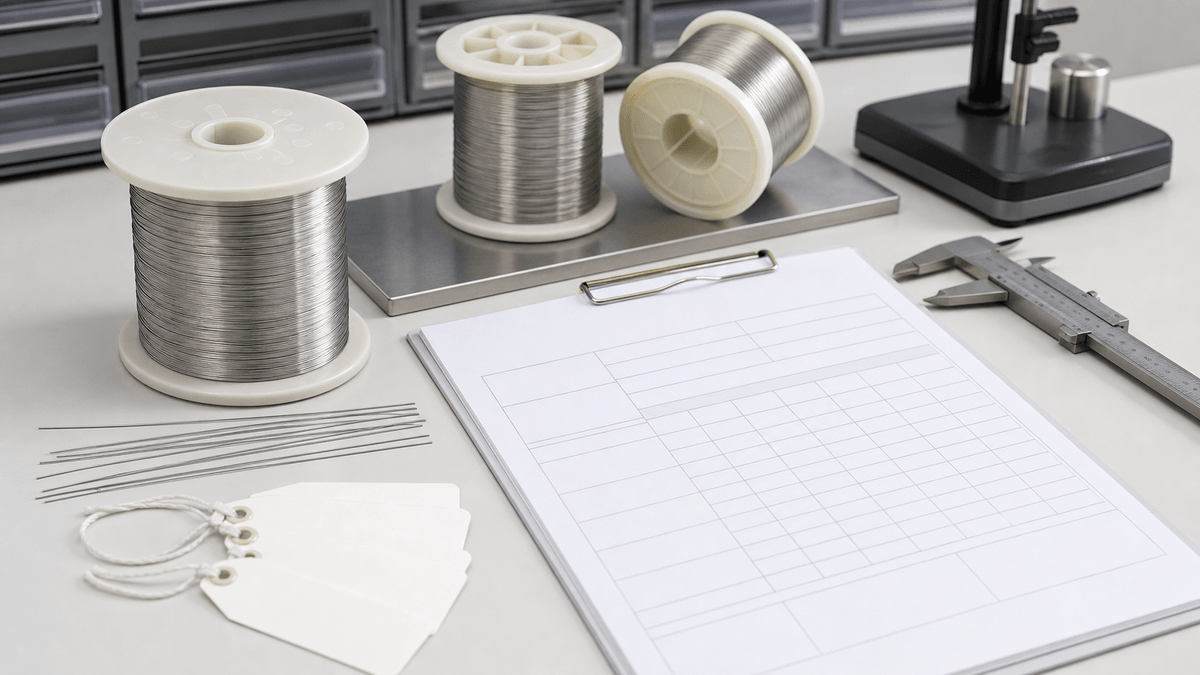
Buyers may write CuNiTiCr, Cu NiTiCr, NiTiCuCr, copper niticr, or cuniticr wire. These spellings usually point to the same alloy family, but a quote should normalize the term to Copper NiTiCr wire. This avoids confusion with Copper NiTi ternary alloy, binary NiTi, or other NiTi-based materials.
The distinction matters because GEE SMA product notes list Copper NiTi active Af from 45 to 75 degrees C, while Copper NiTiCr is listed from 25 to 45 degrees C. If a buyer expects lower-temperature thermal activation but receives a quote for the wrong alloy family, the sample may miss the intended behavior before the project even starts. GEE SMA's shape memory alloy product range supports that early alloy-family sorting.
Active Af Is the First Functional Control
Active Af is the most practical number in many CuNiTiCr wire requests. It identifies the temperature region where the material finishes transformation to austenite under defined test conditions. For Copper NiTiCr wire used as thermal-activated arch wire raw material, GEE SMA product notes identify 27, 35, and 40 degrees C as common targets, with typical active Af tolerance of +/-2 degrees C.
A tighter tolerance should be discussed instead of assumed. Product notes indicate that +/-1 degrees C control may require dual control of composition and thermomechanical treatment. That is a real manufacturing topic, not a casual line on a quote. GEE SMA's transformation-temperature knowledge is useful when a buyer needs active Af to be treated as a measured material property.
Diameter, Surface, and Delivery Condition
GEE SMA product notes list Copper NiTiCr wire from 0.05 mm [0.002 in.] and up. The requested diameter should match the next operation. Raw round wire for further processing, straight annealed wire for handling, and material intended for later forming do not need the same incoming condition.
Surface finish should also be specified. Product notes list black oxide and mechanically polished surfaces. Black oxide is associated with a diamond-drawn surface. Mechanically polished wire provides a bright metallic surface that may be preferred for visual inspection or downstream cleaning. GEE SMA's nitinol wire manufacturing capability makes this surface-and-size conversation part of the raw material quote, not an afterthought.
Traceability Protects Af Comparison
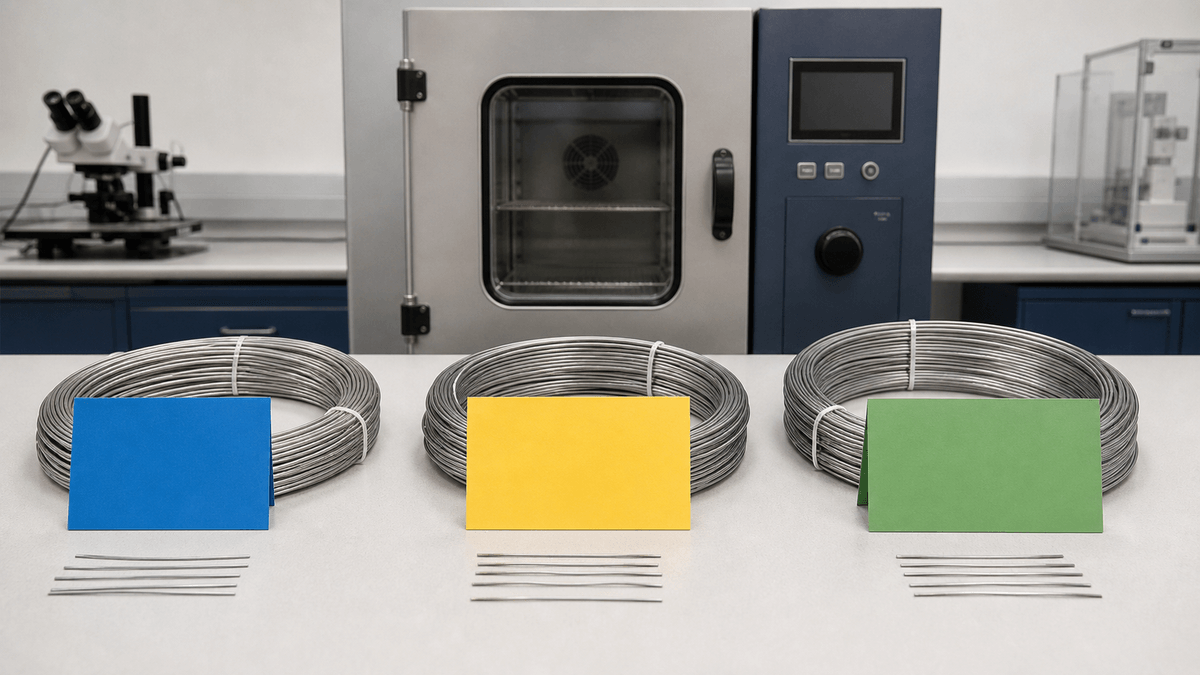
Traceability becomes critical when several active Af targets are sampled side by side. A development team may request 27, 35, and 40 degrees C material, then send those lots through different forming or heat-setting trials. If package marking is weak, test data can become disconnected from the lot that produced it.
GEE SMA product notes describe package marking with alloy code, size, and manufacturer lot number. For fine wire below 1.2 mm, spool packaging with protective wrapping is noted. These details help preserve lot identity and protect wire from handling damage. GEE SMA's Copper NiTiCr wire specification controls reinforce that active Af and package identity belong in the same procurement system.
Use a Process-Aware Sample Plan
A strong sample plan follows the wire through the customer's real process. The buyer should record incoming active Af, diameter, surface, and delivery condition. After drawing, rolling, forming, or heat setting, the buyer should test the processed sample again. If the final behavior moves away from the target window, the team can adjust heat treatment, starting condition, or active Af target in the next lot.
This approach also helps the supplier respond intelligently. Instead of saying that CuNiTiCr wire "did not work," the buyer can identify whether the issue appeared in incoming inspection, after forming, or after final thermal processing. That feedback is much more actionable.
Supplier Comparison Should Use the Same Baseline
CuNiTiCr wire quotes can look similar while describing different materials. One quote may include mechanically polished surface, another may quote black oxide. One may describe straight annealed material, while another provides cold worked stock for further treatment. One may target +/-2 degrees C active Af, while another may leave tolerance unclear. These differences can matter more than a small price gap.
A practical comparison table should include alloy name, active Af target, tolerance, diameter, surface finish, delivery condition, spool or coil package, lot marking, and available test data. When every supplier is compared against the same baseline, the buyer can see whether the quote is truly lower cost or simply less complete.
Incoming Inspection Makes Repeat Orders Easier
Incoming inspection does not need to be complicated for every project, but it should be consistent. At minimum, the buyer should verify package identity, diameter, visible surface condition, and whether the supplied documentation matches the requested active Af. For development work, a few representative samples can be carried through the customer's next process step and tested again.
That record becomes valuable when a prototype works. Instead of reordering from memory, the team can return to the same CuNiTiCr wire specification, same delivery condition, and same active Af target. Repeatability begins with the first sample lot.
Do Not Overlook the Downstream Owner
Many CuNiTiCr wire projects involve more than one company. One supplier may provide raw wire, another processor may roll or shape it, and the product owner may perform final heat setting and validation. The RFQ should identify which party owns each step. If GEE SMA supplies raw or intermediate wire, the downstream owner still needs to confirm final geometry, final surface, and final temperature response after its own process.
This handoff protects the project from vague responsibility. The material supplier controls alloy, incoming condition, and lot documentation. The downstream process owner controls final forming and final validation. When those boundaries are clear, CuNiTiCr wire development becomes much easier to repeat.
RFQ Checklist for CuNiTiCr Wire
- Normalize the material name as Copper NiTiCr wire or CuNiTiCr wire.
- State the active Af target and tolerance.
- Specify diameter, surface finish, delivery condition, and quantity.
- Describe the downstream process that may change final behavior.
- Request package marking by alloy code, size, and lot number.
- Separate raw material suitability from finished-product validation.
CuNiTiCr wire is most useful when the buyer treats it as a controlled raw material, not just a compact alloy abbreviation. Clean naming, active Af control, surface definition, and traceable lots make the supplier conversation much more reliable.