

Nitinol wire is not a finished behavior packaged on a spool. It is a material state that will be bent, straightened, shape set, polished, joined, or assembled before it performs useful work. Two coils with the same nominal diameter and chemistry can behave differently if their cold work, straightness, transformation temperature, surface, or thermal history differs. A useful purchase specification therefore begins with what the wire must become after delivery.
Delivery Condition Determines the Next Operation

Cold-drawn wire retains substantial deformation from drawing and normally has cast and twist. It is useful when a customer plans to form and heat treat the final geometry. Straight-annealed wire has received a straightening heat treatment and may be supplied for applications that need a straight, superelastic starting form. These conditions are not interchangeable, even when diameter and alloy code match.
GEE SMA's nitinol wire range includes spooled and straight-length formats, multiple alloy families, and black oxide or mechanically polished surfaces. The correct combination should reduce unnecessary reprocessing without removing the customer's ability to create the final functional state.
A Spool Adds Geometry to the Material
Spool diameter, winding tension, package restraint, and time in storage can affect cast, helix, and handling. Fine wire may spring away from fixtures; heavier wire may retain curvature that complicates feeding or precision forming. Pulling wire over a small guide or through a damaged eyelet can introduce local bends before production even begins.
An incoming inspection should record spool condition, wire payout, visible damage, diameter, and the amount of free curvature relevant to the process. GEE SMA's diameter and behavior controls reinforce why package geometry and wire mechanics should be reviewed together.
Forming Changes the Question From Material to Component
Once wire is wound into a spring, bent into a frame, tapered into a core, or constrained in a fixture, the product has acquired new strain and geometry. A material certificate cannot predict every consequence of tooling contact, bend radius, residual stress, or local section change. The forming route should define allowable strain, tool condition, intermediate inspection, and the geometry that enters heat treatment.
For programs that require complex paths, GEE SMA's custom component capability is most useful when the drawing includes functional datums and acceptance conditions rather than shape alone.
Heat Treatment Creates the Working State
Shape-setting time, temperature, fixture constraint, section size, prior cold work, and cooling route can change transformation temperature, plateau stress, recovery, and permanent-set resistance. A furnace setpoint is therefore not a complete process description. Teams should verify actual load configuration, fixture revision, time at condition, cooling method, and the output measured after the full cycle.
GEE SMA's transformation-temperature and processing data distinguish intrinsic alloy behavior from active response in processed wire. That distinction matters whenever a customer heat treats supplied wire into a new form.
Surface Finish Must Match the Conversion Route
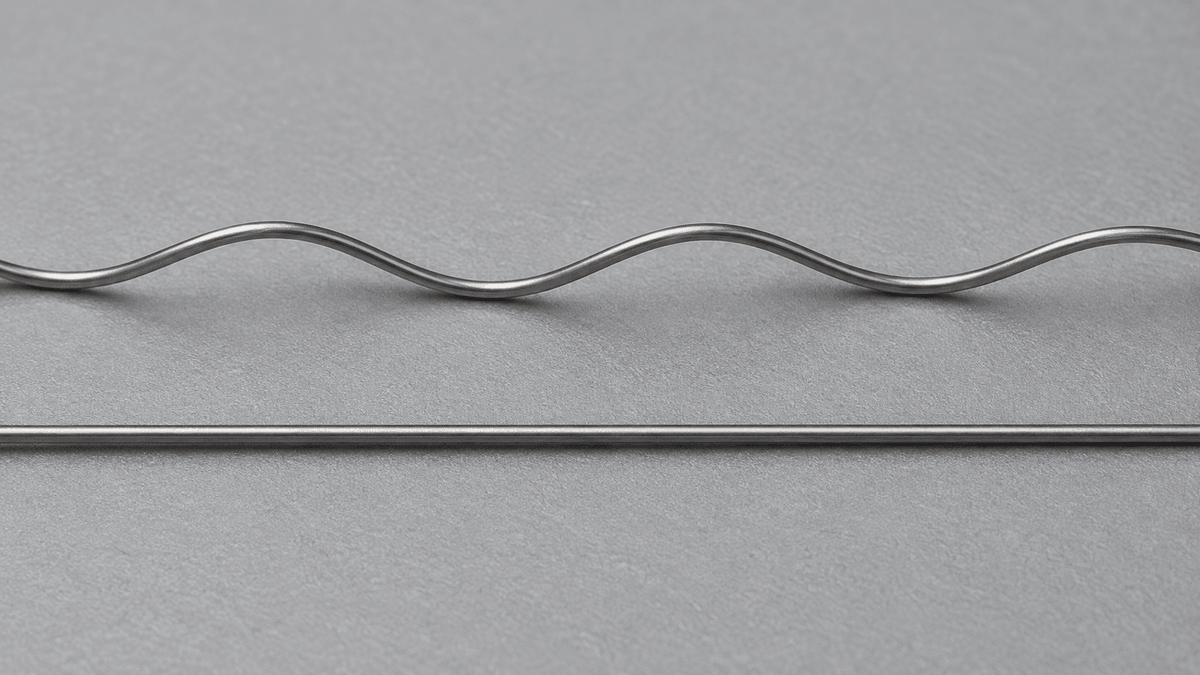
Black oxide may be acceptable when later oxide removal is planned. A light-oxide or mechanically polished surface may reduce downstream work, but forming, heat treatment, joining, and handling can alter it again. Brightness alone does not establish cleanliness, corrosion performance, or final suitability.
Specify incoming appearance, permitted defects, downstream surface removal, final cleaning, and protection during packaging. GEE SMA's forming and surface sequence connects these decisions instead of treating finish as a cosmetic option.
Match Incoming Evidence to the Conversion Risk
Not every program needs the same incoming test package. A wire that will be heavily formed and fully refinished may need strong controls on chemistry, dimensions, cold-work state, and surface defects but will not retain its supplied appearance. A straight wire used with minimal processing places more weight on straightness, active Af, mechanical response, and delivered surface. The inspection plan should protect the characteristics that survive into the next operation.
| Downstream route | Incoming priorities |
|---|---|
| Form and shape set | Cold-work condition, diameter, cast, surface integrity, heat identity |
| Use as straight superelastic wire | Straightness, active Af, tensile response at use temperature, surface |
| Polish or coat later | Starting oxide, removal allowance, dimensional margin, defect limits |
This risk-based approach also prevents duplicate testing. Supplier results can support incoming acceptance when methods and sampling agree, while the converter repeats the properties that its own forming, heat treatment, or finishing can change.
Transfer the Acceptance Method With the Wire
A diameter result without location and method may hide variation across a coil. An Af result without specimen condition and test method may not describe active performance. A tensile curve without test temperature, strain rate, and preconditioning cannot be compared reliably with another supplier's data.
The receiving plan should identify the lot, sampling positions, delivery condition, dimensional method, transformation method, mechanical-test temperature, surface criteria, packaging, and retained sample. ASTM F2063 provides a useful material framework for applicable medical mill products, but the customer still has to define the final component requirements.
Common handoff failures are practical rather than exotic: the certificate reports DSC on fully annealed material while production expects active Af; straight wire is repackaged around too small a diameter; a polished wire is scratched by a feed guide; or a replacement spool changes cast enough to disturb automated forming. Recording the intended conversion route gives both sides a way to recognize these risks before a nonconformance appears.
Send a Conversion Map With the RFQ
- Final product form and critical dimensions
- Required alloy family and functional mode
- Cold-drawn or straight-annealed delivery condition
- Coil, spool, or straight-length package
- Planned forming and heat-treatment operations
- Incoming and final surface expectations
- Service and test temperatures
- Lot, sampling, certificate, and change-control needs
A strong nitinol wire order describes the handoff between supplier and converter. GEE SMA's material portfolio can support that handoff when alloy, delivery state, package, and verification are tied to the intended process.