

Specify a nitinol spring actuator sample by the force it must produce at defined positions and temperatures. Include the installed length, the allowable travel and the method used to return the mechanism to its starting position. These details let a supplier assess a spring against the work it must do, and they give the engineering team a repeatable way to evaluate the sample.
Describe how the spring fits into the mechanism
Start by drawing the fixed and moving mounting points. Mark the spring length at rest, at the point where motion is useful and at the mechanical stop. Include the space available around the spring during travel. State whether it works in tension or compression, and identify the end conditions that matter to the test, such as a guided seat or a hooked attachment.
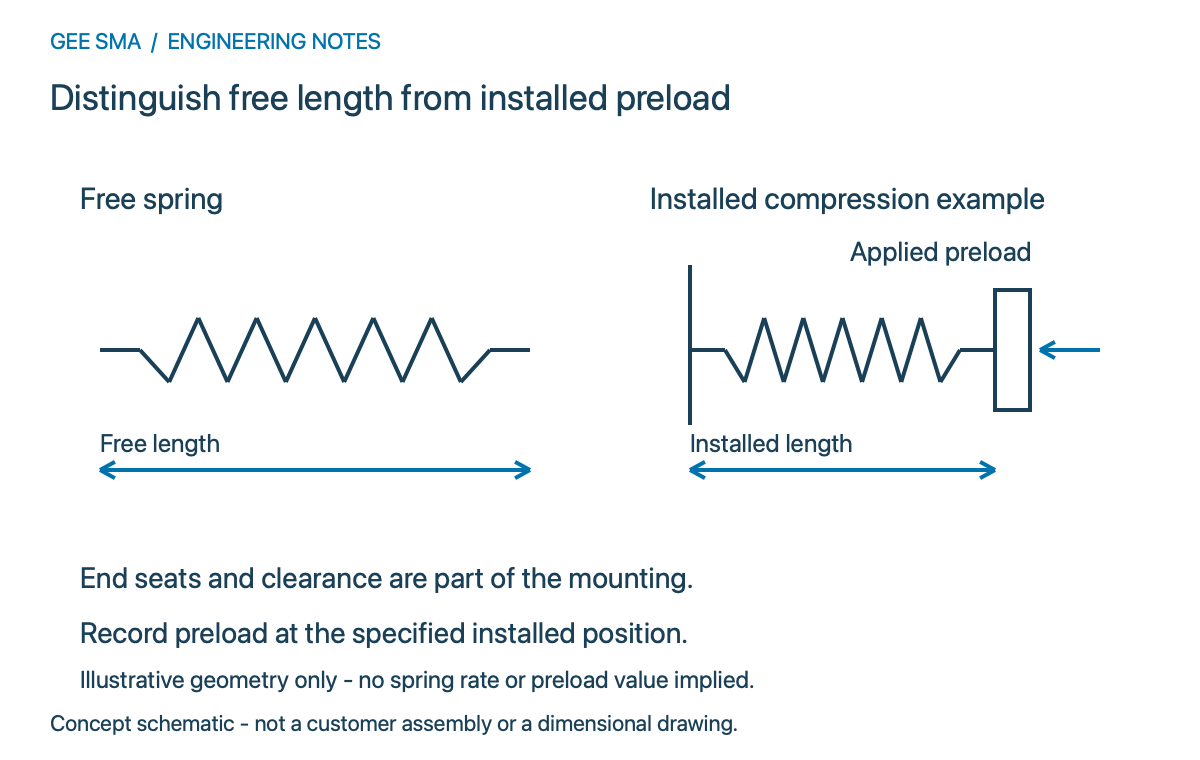
List the available length and diameter as installed dimensions. Free length is also useful on the part drawing, but the spring may be loaded as soon as it is assembled. Show any initial deflection and explain how the preload is measured. The spring supplier needs to know which dimension describes the loose sample and which describes the assembly. A photograph can show the orientation, while a dimensioned drawing keeps the same limits visible during design and purchasing review.
Describe the load at useful points in the stroke
Write down what the spring must do at each critical position. A sample may need to begin movement against a preload, travel across a range of positions and deliver a minimum force near the end. Record the load of the attached mechanism at those locations and identify any friction that varies between directions. When the mechanism changes leverage over the stroke, put the measurement reference on the drawing.
For a nitinol spring actuator, a quoted force is useful when the condition is clear. Specify the spring position and temperature where the force is required, and say whether the measurement applies during heating, cooling or after the sample has stabilized. If displacement is the main output, state the load at which it must be achieved. Between these details, the supplier can see whether the request is a fixed-position force check or a travel check under load.
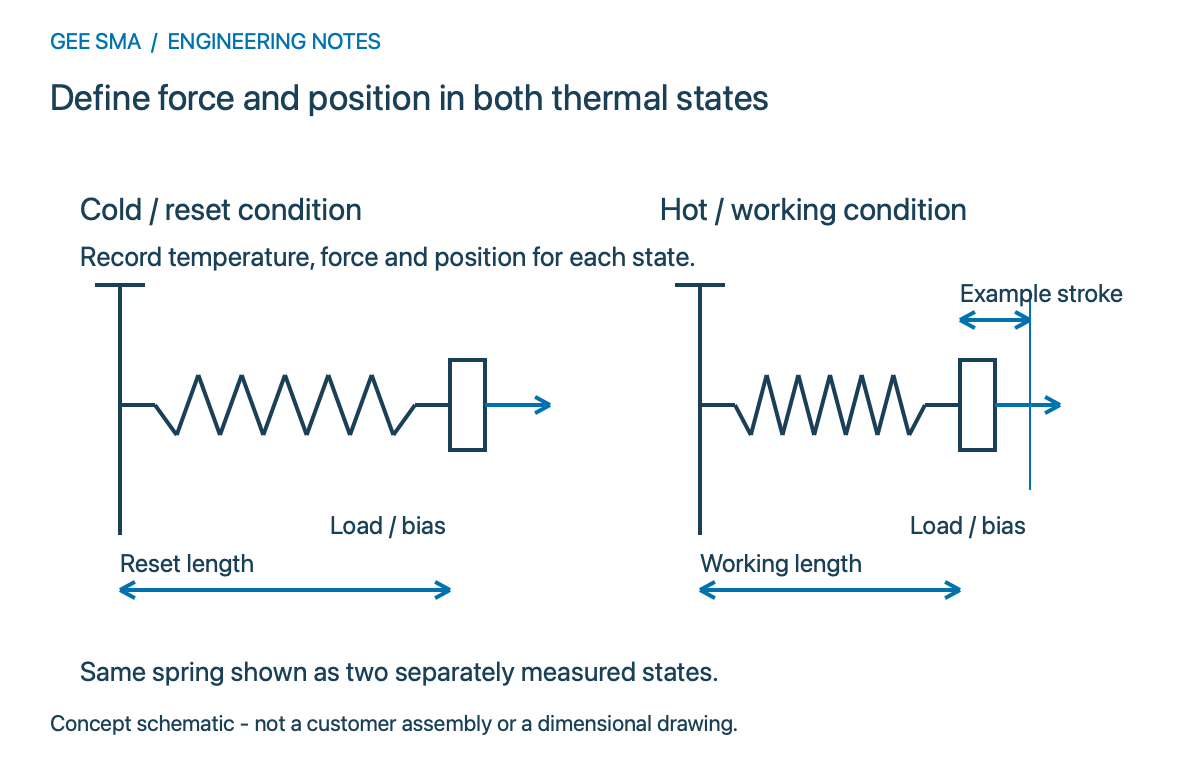
Define hot and cold operating points
For the nitinol spring actuator, use the mechanism’s trigger and reset conditions to define a test matrix. For the hot condition, specify the temperature or heating input and the required force or position. For the cold condition, define the temperature and how far the mechanism needs to return. Include the allowed time to achieve each result if timing matters to the application. Add intermediate points when movement begins before the mechanism can do useful work.
State where temperature will be measured. A reading from the surrounding air or fluid may differ from the temperature of the spring during a transient cycle. If temperature is measured indirectly, write down the location and wait time so a supplier and a receiving team can reproduce the condition. The GEE SMA technical information page distinguishes transformation-temperature data and example spring configurations. Use that information to discuss how the sample will be characterized at the relevant stage.
Make the return mechanism explicit
Describe what moves the assembly back after the hot stroke. The nitinol spring actuator design may rely on an external bias, another load or a spring configuration that has been selected for movement in both temperature directions. Include the force present while the sample cools, and specify the latest acceptable return position. Where the direction of movement changes between tests, label the load and displacement consistently to avoid confusing the hot and cold measurements.
GEE SMA shows one-way and two-way shape memory spring examples. Use these as configurations to discuss. For your mechanism, request evidence that the candidate nitinol spring actuator returns under the load and cooling conditions you intend to use. If the team adjusts the bias or mounting arrangement between trials, record the adjustment with the sample result.
Check repeated motion in the intended mounting
Start with one cycle and record the actual positions, load and temperatures. Once the basic movement is understood, repeat the command or temperature cycle at a representative interval. Track the starting position of later cycles and note changes in the timing of force or movement. This helps distinguish a sample that meets one test point from one that can repeatedly achieve the operating sequence being evaluated.
If the installed nitinol spring actuator behaves differently from a fixture test, compare the measurement setup before changing sample geometry. A guide can add friction, a seat can alter alignment and surrounding parts can affect heating or cooling. Record the spring identification, fixture version, method of heating and the actual command interval. Keep a reference record when moving from a first fit check to a functional prototype. The same sample may be used for different purposes, and the evidence for each test should be easy to identify.
Prepare a sample request with acceptance points
For a nitinol spring actuator inquiry, send a drawing that identifies geometry, mounting and motion, accompanied by a short table of temperatures, force requirements and expected positions. Name the maximum envelope, reset method and timing. Identify any dimensional data or performance records that should accompany the sample. If the project is comparing two options, tell the supplier why the options are being compared and what will remain the same between tests.
For a project still choosing a mechanism, review the GEE SMA wire and spring selection guide. Bring the same operating points to each option so the comparison is based on the same assembly requirement. A request grounded in the intended motion makes it easier to see which design choices belong to the spring and which belong to the surrounding mechanism.
For a second nitinol spring actuator sample, show the original and revised requirements side by side. Specify whether the change is in the mounting position, force at stroke or the cold return point. Retain the unchanged test points so the team can compare the new result against the first sample. This is especially useful when evaluating a nitinol spring actuator in an assembly that has been modified since the initial fit review.
Worked example: Separate spring force from mechanism friction
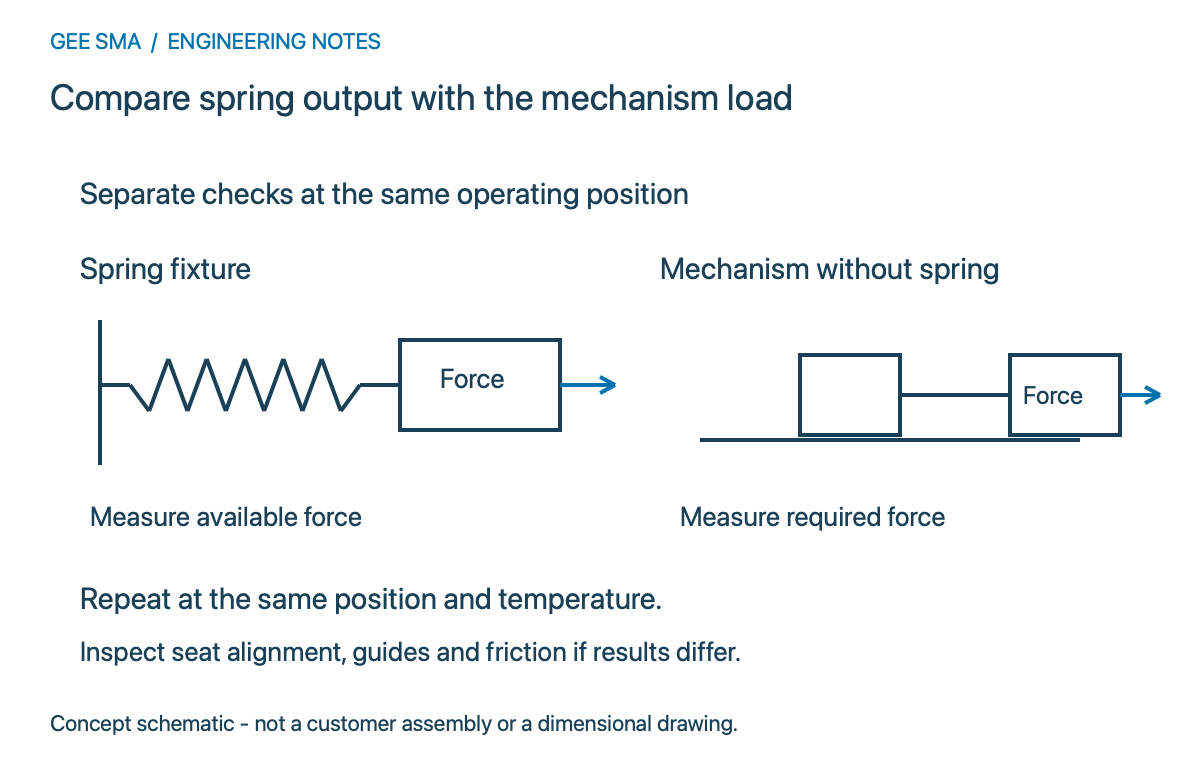
Imagine a temperature-triggered linkage that reaches its target when tested on a bench but stops short after installation. Record the spring length and temperature at the point where the movement stops. Use that same position and temperature to check the spring force in a fixture, then measure the force needed to move the linkage through that point without the spring attached. This links the nitinol spring actuator result to the load that the installed mechanism actually presents.
Compare the fixture geometry with the installed mounting before using the force readings. A spring seat that tilts under load or a guide that changes position can move the point of resistance. Run the return check under the same mounting and load as the hot stroke. If the spring reaches the required positions on the bench and the installation consistently changes the load, document both results in the sample review. This gives the supplier a specific comparison and gives the assembly team a reason to inspect the mounting.
Frequently asked questions
Should I specify free length or installed length?
Include both when they matter to the drawing and the test. Free length describes the spring before loading. Installed length locates the spring in its actual mechanism and may reflect preload that is present before any heating.
Can I use Active Af as my only acceptance requirement?
Active Af helps describe the material condition. A sample evaluation also needs the force or movement required at the relevant positions and temperatures, together with the conditions under which the readings are taken.
How do I define a cold return check?
Set the cold test temperature, the load or bias present and the position the mechanism must reach. Add a time limit if commands are repeated. Record where temperature and displacement are measured so the result can be reproduced.
What should I send for a first sample?
Send the mechanism drawing, mounted dimensions, expected hot and cold states and the load at the critical positions. Explain whether the first test is for fit, one complete motion cycle or a repeating duty cycle.