

A nitinol company can list wire, tube, sheet, strip, springs, and custom components without controlling the operations that determine how those products behave. For an OEM, the useful question is not how many forms appear in a catalog. It is which material and processing steps the supplier owns, measures, documents, and can repeat when the order moves from samples to production.
GEE SMA product notes describe a portfolio spanning ingot, rod, wire, sheet, plate, foil, strip, springs, and formed components. That breadth matters because its wrought NiTi product forms can support related programs, but a buyer should still audit the process chain behind the exact part being sourced.
Map the Process Chain Before the Capability List
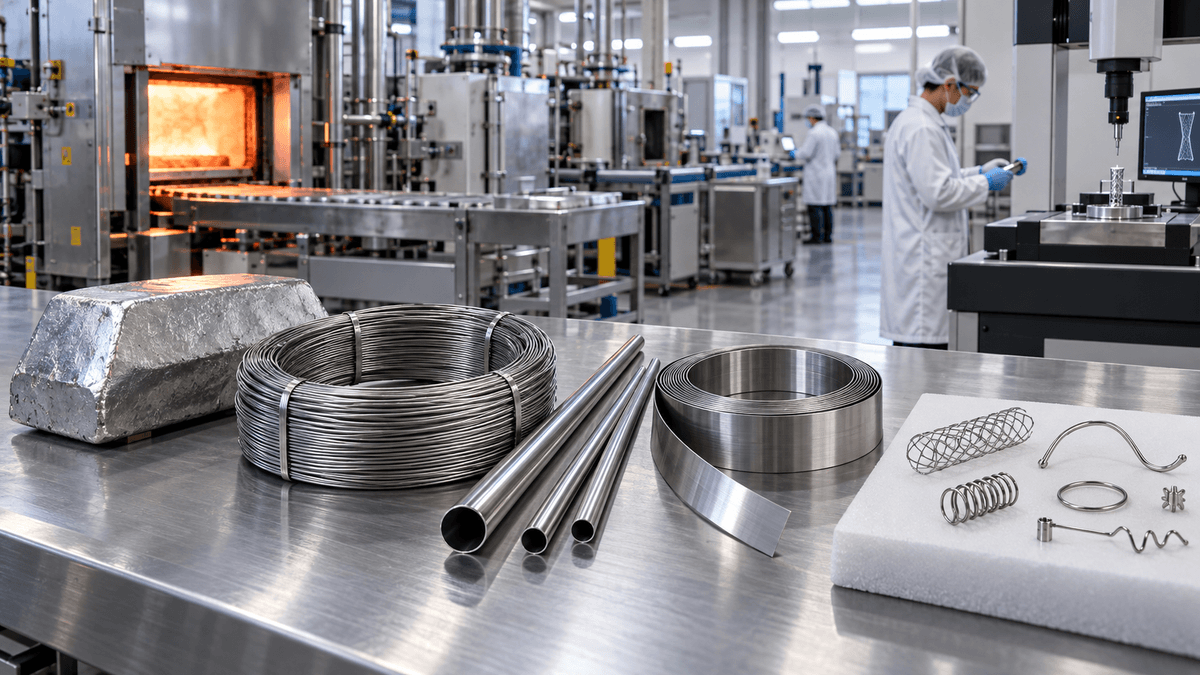
Begin with a flow map from melt source through breakdown, cold work, intermediate annealing, final sizing, shape setting, surface finishing, inspection, packaging, and shipment. Mark which steps are performed internally, which are outsourced, and where material identity changes hands. Outsourcing is not automatically a weakness, but ownership of specifications, supplier controls, records, and acceptance criteria must remain clear.
For a wire program, ask who controls drawing reduction, straightening, final heat treatment, and surface condition. For a laser-cut component, include tube preparation, cutting, oxide removal, electropolishing, cleaning, and dimensional inspection. GEE SMA's process-focused technical controls give an audit a more useful starting point than a generic promise of NiTi expertise.
Ask Where Functional Properties Are Created
Nitinol composition establishes potential behavior, but cold work and heat treatment strongly influence transformation temperature, plateau response, strength, recovery, and dimensional stability. A supplier should be able to identify the operation that creates the delivered functional condition and the test that verifies it.
For superelastic material, ask for test temperature and the method used to report plateau strength and residual elongation. ASTM F2516-22 ties tension-test results to the test condition. For shape-memory material, identify whether Active Af applies before or after shape setting and whether DSC or bend-and-free-recovery data are used. GEE SMA's wire families and delivery conditions are most useful when those verification details are included in the RFQ.
Review Surface Routes as Manufacturing Processes
Terms such as black oxide, light oxide, pickled, and mechanically polished describe starting conditions, not complete performance claims. The audit should examine how surfaces are produced, inspected, protected, and transferred into downstream customer operations. Scratches, embedded debris, heat-treatment scale, and handling damage can affect corrosion, friction, coating, joining, and fatigue.
Request visual standards or representative samples where appearance matters, and define defect language for the actual product form. GEE SMA's forming and surface-control route shows why the final thermal and mechanical history belongs in the same review as finish.
Trace One Lot From Incoming Material to Shipment

A paper audit becomes more revealing when the supplier traces one real lot. Follow the heat or melt identifier into travelers, inspection records, transformation-temperature results, dimensional data, nonconformance records, packaging labels, and the final certificate. Confirm how split lots, rework, mixed furnaces, and partial shipments are recorded.
Medical-device customers should align supplier evidence with their own quality system and risk controls. ISO 13485:2016 remains current and emphasizes risk-based quality management across the medical-device supply chain, but a certificate does not eliminate the need to qualify the supplied process. GEE SMA's melt-to-surface evidence model is a practical template for deciding which records need to travel with medical nitinol wire.
Challenge Change Control With Specific Examples
Ask what happens if the melt source changes, a drawing die is replaced, a furnace is moved, a straightening method changes, an outsourced finisher changes chemistry, or packaging material is substituted. The answer should identify notification thresholds, revalidation, retained records, and customer approval where contractually required.
Also ask how process drift is detected before a formal change occurs. Statistical trends in diameter, Active Af, plateau stress, straightness, or surface rejects may reveal movement that a pass/fail certificate hides. A capable nitinol company should connect these signals to investigation and containment.
Scale-Up Evidence Should Match the Quoted Route
A hand-selected prototype can pass while production material varies across coil length, furnace position, tooling life, or operator shift. The supplier review should compare prototype and production equipment, batch size, sampling plan, and expected lead time. If the route changes at scale, require representative production-intent samples before design verification.
GEE SMA's custom NiTi component support is relevant when wire forming, shape setting, joining, or finishing must migrate together. The drawing and control plan should state which dimensions and functional results are released at material level and which are released at component level.
A Practical Nitinol Company Audit List
- Process map, internal and outsourced operations, and ownership at every handoff.
- Alloy identification, melt traceability, delivery condition, and retained cold work.
- Transformation-temperature and mechanical test methods, temperatures, and sampling.
- Surface routes, visual standards, cleaning, handling, and protective packaging.
- Calibration, furnace uniformity, tooling control, nonconformance, and rework records.
- Change-notification rules and production-intent scale-up evidence.
- Certificate content matched to the OEM's drawing and risk controls.
The right nitinol company is the one that can show how a defined material state survives every controlled operation and arrives with evidence that matches the buyer's use. Catalog breadth opens the conversation; process ownership makes the supply relationship dependable.